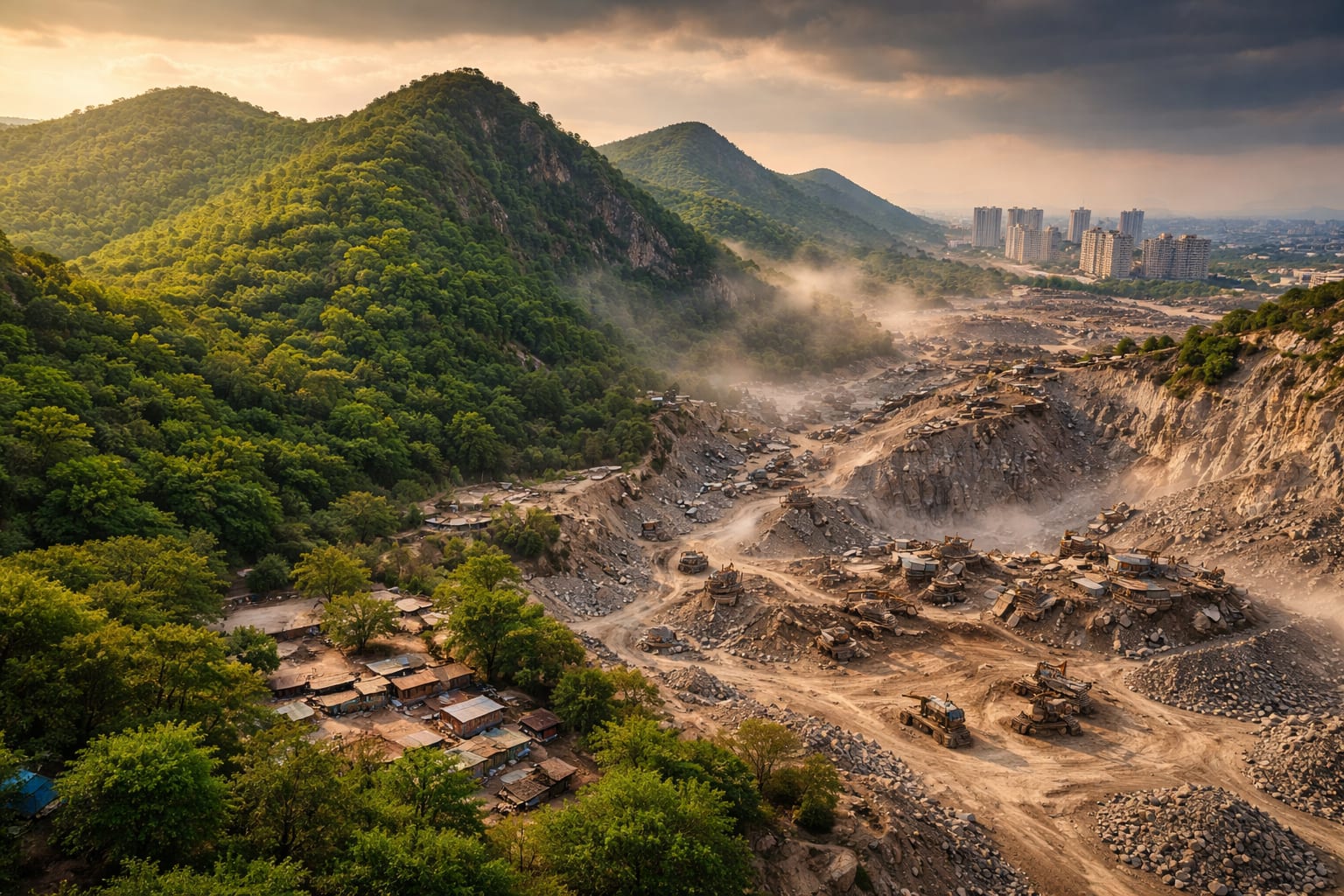
The Aravali Hills are not just a geographical feature of India; they are a living natural system that has protected North India for thousands of years. From controlling desertification to regulating climate and supporting biodiversity, the Aravali range plays a critical role in maintaining ecological balance. In recent years, however, increasing industrial pressure, mining activities, and real estate expansion have put these ancient hills at serious risk.
The recent Supreme Court judgment delivered on 20 November 2025 regarding activities in the Aravali region has once again brought national attention to the tension between environmental protection and economic development. This judgment is not an isolated legal decision; it is connected to decades of environmental litigation, policy conflicts, and social consequences that directly affect ordinary citizens.
What Are the Aravali Hills?
The Aravali Hills are one of the oldest mountain ranges in the world, dating back nearly 1.5 billion years. Stretching approximately 670 kilometers, they run from Gujarat through Rajasthan and Haryana, ending near Delhi. These hills act as a natural barrier that prevents the Thar Desert from expanding eastward and plays a crucial role in protecting fertile land and urban regions.
Unlike younger mountain ranges, the Aravali system is fragile. Once damaged, it cannot be naturally restored within a human lifetime. This makes any form of mining, deforestation, or construction especially dangerous for long-term environmental stability.
Geographical and Environmental Importance
The Aravali range supports forests, wildlife corridors, underground aquifers, and seasonal rivers. It influences rainfall patterns in North India and helps regulate temperature. Regions like Delhi-NCR, Haryana, and western Uttar Pradesh indirectly depend on Aravali forests for breathable air and groundwater recharge.
Over the years, however, large sections of the Aravali hills have been flattened or fragmented. What was once continuous forest cover is now broken into industrial zones, highways, and luxury housing projects.
The Supreme Court Judgment of 20 November 2025
On 20 November 2025, the Supreme Court of India delivered a significant judgment concerning activities permitted in the Aravali region. The judgment addressed ongoing disputes related to land use, mining permissions, construction, and environmental clearances granted by state authorities over the years.
While the Court reiterated the importance of environmental protection, it also acknowledged the existing economic activities and infrastructure projects already underway. This balance between conservation and development has become the most debated aspect of the judgment.
Why This Judgment Matters
The ruling has implications for future industrial permissions, real estate development, and mining operations in ecologically sensitive zones. Environmentalists argue that even limited permissions weaken decades of conservation efforts, while governments defend such decisions citing employment, investment, and revenue generation.
The judgment reflects a broader national dilemma: how much environmental damage is acceptable in the name of economic growth, and who ultimately bears the cost of that damage.
Who Is T.N. Godavarman?
T.N. Godavarman Thirumulpad is one of the most influential figures in India’s environmental jurisprudence. He is best known for filing the landmark forest conservation case in the Supreme Court, which transformed how forests are legally defined and protected in India.
His petitions led to stricter monitoring of forest land use, the creation of expert committees, and judicial oversight of environmental governance. Many Aravali-related cases are directly or indirectly influenced by the legal principles established through the Godavarman case.
Previous Aravali-Related Judgments
Over the past two decades, courts have repeatedly intervened to restrict mining and construction in the Aravali region. Earlier judgments emphasized that the Aravali hills must be treated as forest land regardless of revenue records, highlighting their ecological value over commercial classification.
Despite these rulings, enforcement has remained inconsistent due to administrative loopholes, reclassification of land, and political pressure.
Benefits of Protecting the Aravali Hills
- Prevention of desertification and soil erosion
- Natural air filtration for polluted urban regions
- Groundwater recharge and water security
- Temperature regulation and climate resilience
- Protection of wildlife and biodiversity
Losses Caused by Damaging the Aravali Hills
Destruction of the Aravali range has direct and indirect consequences. Rising air pollution, water scarcity, heatwaves, and declining agricultural productivity are already visible in surrounding regions.
These environmental losses translate into health costs, reduced quality of life, and increased vulnerability for people who cannot afford technological protections.
NDTV Ground Reality Reports
Ground reports by independent media outlets, including NDTV, have repeatedly shown the gap between official claims and on-ground reality in the Aravali region. Illegal mining, unregulated construction, and deforestation continue despite court orders.
Villagers living near these regions report declining water levels, increased dust pollution, and loss of grazing land. Their concerns rarely translate into policy changes.
Why Do Courts Allow Certain Activities?
Courts often face complex situations where completely halting projects may affect existing investments, employment, and infrastructure development. Governments argue that controlled development is necessary for economic growth.
However, this development model is largely business-driven and profit-oriented, benefiting corporations and state revenues more than local communities.
Who Really Pays the Price?
The environmental cost of such decisions is not equally shared. Wealthy individuals can afford air purifiers, private healthcare, and relocation to cleaner areas. Poor and middle-class families cannot.
People living near the Aravali region often depend on local resources for survival. There are limited job opportunities in villages, forcing people to stay in polluted and degraded environments. They suffer from respiratory diseases, water shortages, and rising living costs—despite having contributed least to the damage.
This creates a deep environmental injustice where economic benefits are centralized, while environmental and health burdens are pushed onto vulnerable populations.
Long-Term Impact on Delhi-NCR and Surrounding Regions
The impact of damage to the Aravali Hills is not limited to rural or forested areas. One of the most affected regions is Delhi-NCR, where air pollution, water scarcity, and extreme weather events have become regular challenges. The Aravali range acts as a natural shield that filters dust, controls wind movement from desert regions, and regulates temperature.
As large sections of the Aravali hills are degraded or removed, this protective barrier weakens. Dust storms originating from the Thar Desert and mining zones travel more freely toward urban areas, contributing to severe air quality deterioration in cities like Delhi, Gurugram, Faridabad, and Noida.
Impact on Air Quality and Rising Pollution Levels
Scientific studies and environmental monitoring data have shown that forest cover in the Aravali region plays a significant role in reducing particulate matter in the air. When vegetation is cleared, fine dust particles remain suspended in the atmosphere for longer periods, increasing health risks.
Poor air quality does not affect everyone equally. Corporate offices, luxury homes, and high-income neighborhoods often rely on air purifiers and controlled indoor environments. In contrast, the majority of the population—street vendors, construction workers, delivery workers, and daily wage earners—spend most of their time outdoors, directly inhaling polluted air.
Water Crisis and Groundwater Depletion
The Aravali hills are crucial for groundwater recharge. Rainwater that flows through forest soil slowly percolates into underground aquifers. When hills are flattened and soil is compacted by heavy machinery, this natural recharge system collapses.
As a result, water tables in Haryana, Rajasthan, and parts of Delhi-NCR are falling rapidly. Tanker water has become a necessity rather than an emergency solution. Once again, the financial burden of purchasing water falls disproportionately on middle- and lower-income families.
Climate Change and Rising Temperatures
The Aravali range contributes to temperature regulation by maintaining green cover and moisture levels in the atmosphere. Deforestation increases surface temperatures, intensifies heatwaves, and reduces local rainfall.
Urban heat islands expand as natural buffers disappear. Heat-related illnesses, loss of productivity, and higher electricity bills for cooling become unavoidable consequences. These costs are rarely included in economic growth calculations.
Public Health Consequences
Long-term exposure to polluted air and contaminated water leads to respiratory diseases, cardiovascular problems, skin disorders, and weakened immunity. Children and elderly individuals are particularly vulnerable.
Access to quality healthcare remains unequal. While affluent citizens can seek private medical treatment, government hospitals serving lower-income populations are often overburdened. Environmental damage thus transforms into a public health crisis, silently affecting millions.
Social and Economic Stress on Vulnerable Communities
Environmental degradation reduces agricultural productivity, affects livestock health, and destroys traditional livelihoods. Migration to cities increases as rural employment opportunities decline, adding pressure to already stressed urban infrastructure.
Ironically, those who contribute least to environmental destruction are the ones who suffer the most. This imbalance highlights a systemic failure where environmental costs are externalized onto communities with the least economic and political power.
Governance Failures in Protecting the Aravali Hills
The ongoing degradation of the Aravali Hills cannot be attributed to a single institution. It is the result of long-standing governance failures involving multiple layers of administration. Despite clear judicial directions over the years, implementation on the ground has remained weak, inconsistent, and often selective.
Environmental protection in India is shared between central, state, and local authorities. This fragmented responsibility creates confusion and allows accountability to be shifted from one authority to another. In the case of the Aravali region, this administrative complexity has frequently worked in favor of commercial interests rather than conservation.
Policy Loopholes and Land Reclassification
One of the most significant loopholes involves the classification of land. Many ecologically sensitive areas in the Aravali range are recorded as “revenue land” rather than “forest land” in official documents. This technical distinction allows construction and mining activities to continue legally, even though the ecological function of the land remains the same.
Over time, state governments have amended local laws and notifications to dilute protections. These changes are often justified as necessary for development, housing, or industrial expansion, but they rarely account for cumulative environmental impact.
Environmental Clearances and Compliance Gaps
Environmental Impact Assessments (EIAs) are meant to evaluate the potential harm of large projects before approval. However, in practice, EIAs are often rushed, based on incomplete data, or prepared by agencies hired by project proponents themselves.
Post-approval monitoring is even weaker. Conditions imposed by environmental authorities are rarely enforced strictly. Violations result in minimal penalties that do not act as real deterrents for large corporations with significant financial resources.
Role of State Governments and Economic Pressure
State governments face constant pressure to attract investment, generate employment, and increase revenue. In this competition-driven environment, environmental safeguards are often seen as obstacles rather than long-term assets.
Decisions regarding land use in the Aravali region are frequently influenced by short-term economic gains. Large infrastructure projects and real estate developments are promoted as symbols of progress, even when their environmental costs are irreversible.
Limited Representation of Affected Communities
Communities living in and around the Aravali Hills have minimal participation in decision-making processes. Public hearings, where conducted, are often procedural rather than meaningful. Language barriers, lack of awareness, and power imbalances limit genuine public engagement.
As a result, the voices of farmers, tribal groups, and informal workers are overshadowed by corporate and political interests. Their lived experiences of environmental decline rarely influence policy outcomes.
Judicial Oversight Versus Executive Action
Courts have repeatedly emphasized the need to protect the Aravali ecosystem. However, judicial intervention alone cannot substitute effective executive governance. Court orders depend on administrative machinery for enforcement, which remains uneven.
This gap between judicial intent and executive action creates a situation where environmental protection exists more strongly on paper than in reality. Without transparent governance, independent monitoring, and political will, legal protections remain fragile.
Accountability and the Way Forward
True accountability requires more than legal judgments. It demands transparent land records, independent environmental audits, and strict enforcement of violations. Officials responsible for approving harmful projects must be held answerable for long-term consequences.
Strengthening local governance, empowering affected communities, and integrating environmental costs into economic planning are essential steps. Without these reforms, the Aravali Hills will continue to erode—not only physically, but also as a symbol of environmental justice.
Sustainable Development in the Aravali Region
The debate surrounding the Aravali Hills is often framed as a choice between environment and development. In reality, this is a false binary. Sustainable development offers a pathway where economic progress can coexist with environmental protection, provided that planning is long-term, inclusive, and science-based.
The Aravali ecosystem, if protected and restored, can itself become a source of sustainable livelihoods. Forest conservation, water management, eco-tourism, and climate-resilient agriculture can generate employment without causing irreversible damage.
Restoration and Regeneration of Degraded Areas
Large portions of the Aravali range have already been degraded due to mining and construction. Restoration of these areas is both possible and necessary. Native tree plantation, soil stabilization, and revival of traditional water bodies can gradually rebuild ecological functions.
Such restoration projects can be employment-intensive, providing local jobs while improving environmental health. This approach shifts development from extraction to regeneration.
Rethinking Urban Expansion and Real Estate Growth
Unplanned urban sprawl is one of the biggest threats to the Aravali Hills. Instead of expanding cities into ecologically sensitive zones, urban policy must focus on vertical growth, redevelopment of existing urban areas, and efficient land use.
Affordable housing and infrastructure can be developed on already degraded land rather than forested hills. This requires strong political will and resistance to speculative real estate interests.
Economic Valuation of Ecosystem Services
One of the reasons environmental damage continues is that nature’s services are rarely included in economic calculations. The Aravali Hills provide clean air, water security, climate regulation, and disaster prevention—services that would cost enormous amounts to replace artificially.
Assigning economic value to these ecosystem services can shift policy priorities. When the long-term cost of environmental degradation is made visible, destructive projects become less attractive.
Inclusive Decision-Making and Community Participation
Sustainable development cannot succeed without the participation of local communities. People living in the Aravali region possess traditional knowledge about land, water, and ecology that is often ignored in formal planning.
Genuine public consultation, transparent hearings, and community consent must become central to development decisions. This reduces conflict and leads to more durable outcomes.
Environmental Justice and Social Equity
Any development model must address the unequal distribution of environmental harm. Policies should recognize that poor and middle-class populations bear a disproportionate share of pollution, health risks, and resource scarcity.
Measures such as improved public healthcare, clean public transport, affordable housing, and access to clean water are not compensations but rights. Environmental protection and social justice must be treated as interconnected goals.
Role of Technology and Innovation
Technology can support conservation through satellite monitoring, transparent land records, and real-time pollution tracking. However, technology must complement—not replace—strong governance and ethical decision-making.
Innovation should be directed toward reducing environmental impact, not merely masking its consequences for those who can afford technological solutions.
Conclusion: The Future of the Aravali Hills and Our Collective Responsibility
The story of the Aravali Hills is not just about forests, courtrooms, or development projects. It is a reflection of how modern society values nature, people, and long-term well-being. The Supreme Court judgment of 20 November 2025 stands at the intersection of environmental protection and economic ambition, highlighting both the strengths and limitations of legal intervention.
While the judiciary has repeatedly acknowledged the ecological importance of the Aravali range, court decisions alone cannot safeguard an ecosystem as ancient and fragile as this. Laws are effective only when supported by responsible governance, transparent policy-making, and genuine public participation.
Beyond Legal Compliance
Protecting the Aravali Hills requires moving beyond the minimum standards of legal compliance. It demands ethical decision-making that considers long-term environmental costs alongside short-term economic benefits. Development that undermines natural systems ultimately weakens the very foundations of economic stability.
When forests disappear, the cost reappears in the form of polluted air, water scarcity, health emergencies, and climate instability. These costs do not vanish; they are transferred to society, especially to those least equipped to bear them.
Who Development Is Really For
A critical question remains unanswered in many policy discussions: who truly benefits from development? Large corporations, investors, and urban elites often gain access to cleaner environments, better healthcare, and technological safeguards.
In contrast, poor and middle-class communities continue to live near polluted zones, breathe unsafe air, consume contaminated water, and face rising medical expenses. They do not have the financial freedom to relocate or shield themselves from environmental harm, yet they pay the highest price for decisions they did not make.
Environmental Protection as Social Justice
The protection of the Aravali Hills is not only an environmental issue but also a matter of social justice. Environmental degradation deepens inequality by placing invisible burdens on already vulnerable populations.
A truly just development model must recognize clean air, water, and a healthy environment as fundamental rights rather than privileges reserved for those who can afford them.
A Choice for the Future
India stands at a crucial crossroads. The choices made today regarding the Aravali Hills will shape the environmental health of North India for generations. Once destroyed, these ancient hills cannot be rebuilt through technology or policy adjustments.
Protecting the Aravali range is not an obstacle to progress; it is an investment in climate resilience, public health, and sustainable economic growth. The real measure of development lies not in the number of projects approved, but in the quality of life preserved for present and future citizens.
Final Reflection
The Aravali Hills have stood for billions of years, silently supporting life across regions. Whether they continue to do so depends on collective responsibility—of governments, courts, businesses, and citizens alike.
The question is no longer whether we can afford to protect the Aravali Hills, but whether we can afford not to.






Discussion
0 comments
No comments yet. Be the first to share your thoughts!