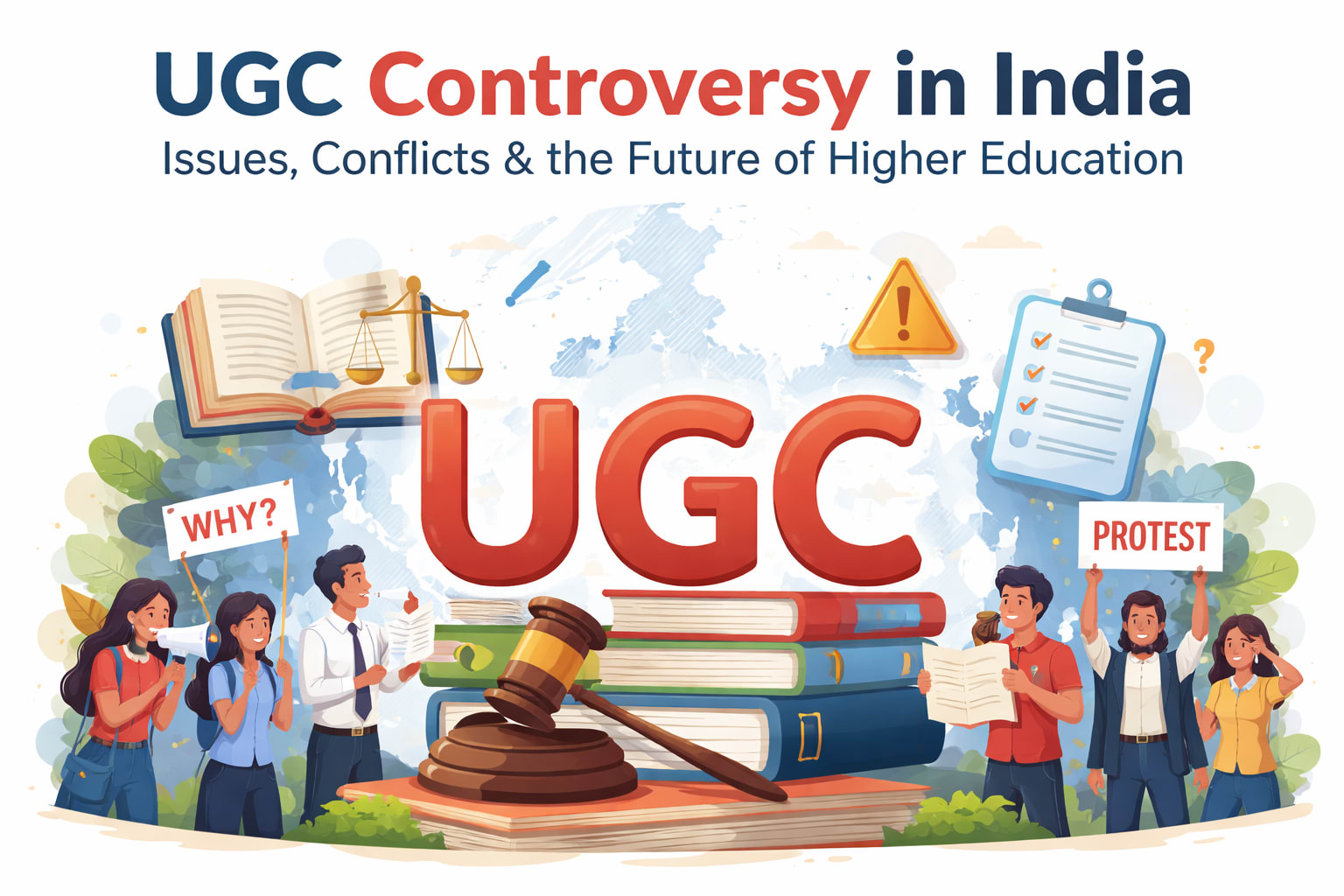
In recent years, the University Grants Commission (UGC) has frequently remained in the spotlight due to continuous debates, protests, student dissatisfaction, and institutional conflicts across India. From changes in academic regulations to examinations, online degrees, PhD rules, and autonomy of universities, UGC decisions have triggered nationwide discussions.
This article provides a complete, unbiased, and descriptive explanation of what UGC is, why contradictions are rising in India, what the real problems are, and what practical solutions can help students, teachers, and institutions move forward.
Table of Contents
- What is UGC?
- Role and Responsibilities of UGC
- History and Evolution of UGC in India
- Why Are Controversies Rising Around UGC?
- UGC Decisions from a Student’s Perspective
- UGC Regulations and Faculty Concerns
- Problems Faced by Universities and Colleges
- What Is the Real Problem?
- Impact on the Indian Education System
- Possible Solutions and Reforms
- Future of UGC in India
- Conclusion
What is UGC?
The University Grants Commission (UGC) is a statutory body set up by the Government of India under the UGC Act, 1956. Its primary responsibility is to coordinate, determine, and maintain standards of higher education across universities in India.
UGC acts as a regulatory authority that decides policies related to academic standards, funding, recognition of universities, eligibility norms for teachers, examination frameworks, and degree validity. Almost every public and private university in India is directly or indirectly influenced by UGC regulations.
In simple words, UGC decides how higher education should function in India, ensuring that students receive quality education and that degrees awarded by institutions remain credible nationwide.
Role and Responsibilities of UGC
The UGC performs multiple roles that affect students, teachers, and educational institutions. Its responsibilities go far beyond funding.
- Providing financial assistance to universities and colleges
- Framing regulations for minimum academic standards
- Recognizing universities and degree programs
- Defining eligibility criteria for teachers and professors
- Promoting research and innovation
- Ensuring uniformity in higher education across states
UGC also collaborates with other regulatory bodies like AICTE, NMC, BCI, and PCI to maintain discipline and clarity in specialized professional education.
History and Evolution of UGC in India
The UGC was formally established in 1956, but its conceptual roots go back to the pre-independence era. After independence, India needed a centralized body to regulate the rapidly expanding higher education sector.
Initially, the UGC focused mainly on funding and development of public universities. Over time, its role expanded to regulation, accreditation support, research promotion, and quality control.
With the rise of private universities, online education, foreign collaborations, and skill-based programs, UGC’s responsibilities became more complex, which also led to disagreements and resistance.
Why Are Controversies Rising Around UGC?
The controversies surrounding UGC are not sudden. They have been building over years due to frequent policy changes, lack of ground-level consultation, and communication gaps.
Major triggers for controversy include sudden regulation updates, examination mandates during crises, changes in PhD rules, online education approvals, and autonomy frameworks that many stakeholders feel are impractical.
Students often feel that UGC policies are imposed without understanding their realities, while teachers and institutions feel burdened by rigid compliance requirements.
UGC Decisions from a Student’s Perspective
For students, UGC decisions directly affect exams, degree validity, admissions, scholarships, and career opportunities.
Issues such as compulsory exams during emergencies, unclear online degree recognition, and frequent syllabus changes have created stress and uncertainty. Many students feel that their voices are not adequately represented during policy formulation.
Another concern is the growing gap between academic curriculum and real-world skills, which students believe UGC has not addressed effectively.
UGC Regulations and Faculty Concerns
Teachers and academic faculty form the backbone of the higher education system, yet many UGC regulations have created dissatisfaction among them. Faculty members often argue that policies are designed without considering the practical challenges faced inside classrooms and research environments.
One of the major concerns is the frequent change in eligibility criteria for recruitment and promotion. Rules related to NET qualification, PhD requirements, API scores, and publication norms have been revised multiple times, creating confusion and insecurity among teachers.
Many educators feel that excessive emphasis on numerical metrics, such as research paper counts and journal indexing, undermines the quality of teaching and meaningful research. This pressure often leads to stress, reduced innovation, and a focus on compliance rather than creativity.
Problems Faced by Universities and Colleges
Universities and colleges across India face significant operational challenges while implementing UGC guidelines. Institutions vary widely in terms of infrastructure, funding, student demographics, and regional constraints, yet UGC regulations often apply uniformly to all.
Smaller state universities and rural colleges struggle to meet accreditation requirements, faculty recruitment norms, and research output expectations due to limited resources. This creates inequality within the higher education ecosystem.
Private institutions, on the other hand, argue that excessive regulation restricts innovation and flexibility. While regulation is necessary to maintain standards, rigid control can discourage experimentation and industry-oriented programs.
Autonomy vs Regulation: A Growing Debate
One of the most debated topics related to UGC is the concept of university autonomy. The idea of granting academic and administrative freedom is intended to encourage innovation, global competitiveness, and institutional growth.
However, critics argue that autonomy often benefits already well-established institutions, while smaller colleges remain tightly regulated. This selective autonomy can increase inequality and create an uneven playing field.
There is also concern that autonomy without accountability may lead to higher fees, commercialization of education, and reduced access for economically weaker students.
Regulatory Overlap and Policy Confusion
Another major source of contradiction is regulatory overlap. Universities often have to follow guidelines from multiple bodies such as UGC, AICTE, state governments, and professional councils.
Conflicting instructions regarding curriculum structure, approval processes, and examination systems create confusion for administrators and students alike. This lack of coordination weakens effective policy implementation.
Many education experts believe that instead of strengthening governance, overlapping regulations increase bureaucratic burden and slow down academic decision-making.
PhD, Research, and Innovation Challenges
UGC regulations related to PhD admissions, coursework, supervisor eligibility, and publication requirements have been a major area of debate.
While the intention is to improve research quality and prevent misuse, strict norms sometimes discourage genuine researchers, especially in social sciences and regional studies.
Limited funding, lack of interdisciplinary support, and pressure to publish in indexed journals reduce the scope for long-term, impactful research.
What Is the Real Problem Behind UGC Contradictions?
The contradictions surrounding UGC are not caused by a single decision or policy. The real problem lies in the gap between policy design and ground-level reality. Most regulations are framed with ideal conditions in mind, while the actual education ecosystem in India is highly diverse.
India’s higher education system includes metropolitan universities, rural colleges, government-funded institutions, private universities, and emerging digital platforms. Applying uniform rules across such varied institutions naturally leads to resistance and dissatisfaction.
Another core issue is limited stakeholder participation. Students, teachers, and local administrators often feel excluded from meaningful consultation during policy formulation. As a result, policies appear imposed rather than collectively developed.
Impact on the Indian Education System
Continuous policy changes and contradictions affect the stability of the higher education system. Universities spend significant time adapting to new rules instead of focusing on academic excellence and innovation.
Students face uncertainty regarding examinations, degree recognition, and career pathways. This uncertainty reduces trust in institutions and increases dependency on private coaching and certifications.
Over-regulation also discourages global collaborations. Foreign universities and research partners often find Indian regulations complex and unpredictable, limiting international academic exchange.
Psychological and Career Impact on Students
The repeated changes in academic rules have a direct psychological impact on students. Stress related to examinations, eligibility criteria, and academic timelines has increased significantly.
Career planning becomes difficult when students are unsure about the acceptance of online degrees, skill-based programs, or interdisciplinary courses. This uncertainty affects confidence and long-term growth.
Many students feel that their education focuses more on compliance rather than employability, creativity, and problem-solving skills.
Online Education, Digital Degrees, and UGC Challenges
The rise of online education has forced UGC to redefine its approach toward digital learning. While online programs increase access and flexibility, concerns about quality and standardization remain.
Frequent updates regarding approval of online degrees have confused both students and institutions. Many learners are unsure whether their qualifications will be accepted by employers or government bodies.
A lack of clear communication and long-term policy vision has slowed down the integration of technology into mainstream higher education.
Social and Economic Impact of UGC Contradictions
Education plays a crucial role in social mobility. When regulations create uncertainty, marginalized and first-generation learners suffer the most.
Rising costs due to autonomy and reduced public funding can limit access to higher education. This widens the gap between privileged and underprivileged students.
In the long term, inconsistent education policies affect workforce quality, innovation capacity, and national economic growth.
Possible Solutions to Resolve UGC Contradictions
Resolving the ongoing contradictions around UGC requires a balanced, inclusive, and long-term approach. The focus should shift from control-based regulation to outcome-based governance.
Policies must be framed after extensive consultation with students, teachers, researchers, and administrators. This participatory approach will improve acceptance and practical implementation.
- Introduce flexible regulations based on institutional capacity
- Ensure stable policies with sufficient transition periods
- Simplify compliance and reduce bureaucratic burden
- Strengthen grievance redressal mechanisms
- Promote quality teaching alongside research output
Role of Students, Teachers, and Institutions
Students must be recognized as primary stakeholders. Regular feedback systems, student representation, and transparent communication channels can bridge trust gaps.
Teachers should be empowered as academic leaders rather than treated merely as compliance units. Continuous professional development and academic freedom are essential for quality education.
Institutions must adopt self-regulation models based on accountability and social responsibility, ensuring that autonomy does not lead to exploitation.
Policy Reforms and Governance Improvements
UGC needs to move towards a transparent, technology-driven governance framework. Data-based decision-making can reduce ambiguity and improve trust.
Regulatory overlap must be addressed through better coordination between UGC, professional councils, and state governments. A unified regulatory framework can reduce confusion.
Research funding should be inclusive, supporting diverse disciplines and regional needs, not just elite institutions.
Future of UGC in India
The future role of UGC should evolve from a regulator to a facilitator of quality education. Its success will depend on adaptability, transparency, and inclusiveness.
With the growth of interdisciplinary learning, digital education, and global collaboration, UGC must ensure that policies remain forward-looking rather than reactive.
A reformed UGC can play a transformative role in positioning India as a global education hub.
Conclusion
The contradictions surrounding UGC in India reflect deeper structural challenges within the higher education system. These conflicts should not be seen as opposition to reform, but as signals demanding better dialogue and design.
A student-centric, teacher-empowered, and institutionally flexible framework can restore trust and effectiveness. Reforming UGC is not about removing regulation, but about making it meaningful and humane.
If addressed thoughtfully, the current debates can become an opportunity to build a stronger, more inclusive, and future-ready higher education system for India.








Discussion
0 comments
No comments yet. Be the first to share your thoughts!