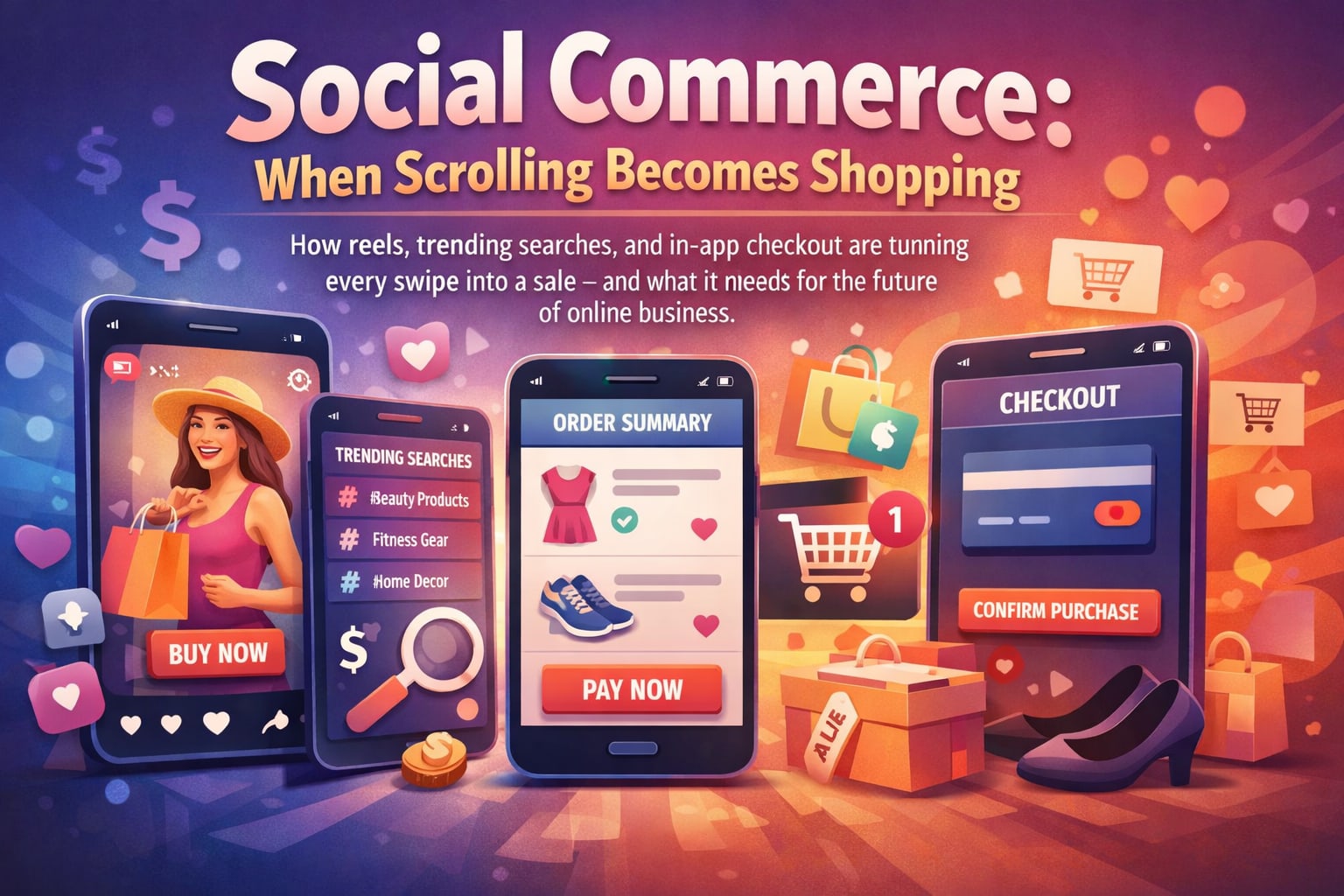
Social Commerce: When Scrolling Becomes Shopping
How reels, trending searches, and in-app checkout are turning every swipe into a sale — and what it means for the future of online business.
📋 Table of Contents
- What Is Social Commerce?
- A Brief History: From Social Media to Social Selling
- Buying Directly from Reels: The New Storefront
- Trending Searches and Discovery Commerce
- Major Platforms Driving Social Commerce
- Key Statistics and Market Size
- Why People Buy Through Social Media
- The Algorithm's Role in Social Shopping
- How Brands Are Winning at Social Commerce
- The Creator Economy and Affiliate Sales
- Challenges and Concerns
- The Future of Social Commerce
- Tips for Businesses to Get Started
- Conclusion
Imagine this: you are watching a short video of someone making a delicious pasta dish. The pan is beautiful. You tap on it. A product card pops up. You click "Buy Now." Done — without ever leaving the app. No new browser tab. No searching on Google. No comparing prices. Just a seamless, almost magical transaction that happened in under 30 seconds.
This is not science fiction. This is social commerce — and it is happening right now, every minute, on platforms like Instagram, TikTok, YouTube, Pinterest, and even WhatsApp. Social commerce is one of the fastest-growing areas of digital retail, and it is reshaping how billions of people around the world discover, evaluate, and buy products.
In this blog, we will explore everything about social commerce — what it is, how it works, why it is booming, which platforms are leading the race, and what businesses can do to ride this wave. Whether you are a business owner, a content creator, or just a curious reader, this guide will give you a complete picture of the social commerce revolution.
1. What Is Social Commerce?
Social commerce is the process of buying and selling products or services directly through social media platforms. Unlike traditional e-commerce, where you visit a separate website or app to shop, social commerce brings the entire shopping experience — discovery, browsing, product details, reviews, and checkout — right inside your social media feed.
Think of it as the marriage of social networking and online shopping. When these two worlds combine, something powerful happens: people stop just "liking" products and start actually buying them, right then and there.
The key difference between regular e-commerce and social commerce is the intent and environment. On Amazon or Flipkart, you go there with a shopping mindset. On Instagram or TikTok, you are there to be entertained — but a product catches your eye, and before you know it, you have made a purchase. This is known as impulse-driven, discovery-led shopping, and it is the heart of social commerce.
Social commerce includes many different formats and features:
- Shoppable posts and videos — product tags on photos and reels
- In-app checkout — completing a purchase without leaving the platform
- Live shopping streams — buying products shown in real-time video
- Swipe-up links and story stickers — quick links to product pages
- Product catalogues in messaging apps — browsing and buying via WhatsApp or Messenger
- Creator affiliate links — clicking a link in a creator's bio or description
- Trending product searches — discovering what's popular and buying it instantly
2. A Brief History: From Social Media to Social Selling
To understand social commerce, it helps to know how we got here. The story starts not with TikTok or Instagram, but with the early days of Facebook.
The Early Days (2005–2012)
When Facebook launched in 2004 and opened to the public in 2006, it was purely a social network. People shared updates, photos, and links. Then Facebook Marketplace quietly began as a place where users could post items for sale in the same way you would on a local classifieds board. It was basic, unpolished, but it planted an important seed: social platforms could be commercial spaces too.
Pinterest, launched in 2010, introduced a visual discovery model that would later prove incredibly valuable for shopping. Users pinned images of products they loved — clothing, furniture, recipes, home décor — and other users followed along. Brands quickly noticed that Pinterest was driving significant referral traffic to their websites.
The Rise of Instagram Shopping (2013–2018)
Instagram changed everything when it introduced Shopping Tags in 2016–2017. Brands could now tag products directly in their photos. Tap the image, see the product name and price, and tap through to buy. It was a revolution in visual commerce. Instagram's highly visual nature made it a perfect environment for showcasing clothing, beauty products, food, and lifestyle goods.
By 2018, Instagram had launched the full Shopping tab and was experimenting with in-app checkout — allowing users to buy without ever visiting an external website.
TikTok and the Short-Video Era (2019–Present)
TikTok's explosive growth starting around 2019 introduced a completely new paradigm. Unlike Instagram, which was still largely about following people you know or admire, TikTok's algorithm showed you content based purely on what you were likely to enjoy — regardless of whether you followed the creator. This made product discovery incredibly powerful. A video of someone trying a skincare product could go viral overnight, selling out stock across the globe.
TikTok Shop, launched officially in multiple markets between 2021 and 2023, brought full in-app shopping to the platform. Sellers could list products, creators could tag them in videos, and viewers could buy within seconds. The phrase #TikTokMadeMeBuyIt became one of the most popular hashtags on the platform, perfectly capturing the social commerce moment.
3. Buying Directly from Reels: The New Storefront
Of all the formats driving social commerce today, short-form video — and particularly Reels on Instagram and Facebook — has become the most powerful. Let us break down exactly how this works and why it is so effective.
What Are Shoppable Reels?
Shoppable Reels are short videos (typically 15 to 90 seconds) in which products are tagged directly. When you watch the video, you might see a small shopping bag icon or a product sticker. Tapping on it brings up a product card showing the name, price, and a link to purchase. On Instagram, you can complete the entire checkout within the app using Instagram Checkout — no need to open a browser.
🛍 How a Shoppable Reel Works — Step by Step
- Creator records a video showing a product in use (e.g., a clothing try-on, a kitchen gadget demo, a makeup tutorial).
- Product tags are added during the editing/publishing stage, linking to an approved product catalogue.
- User watches the Reel and sees the product tag icon appear on screen.
- User taps the tag — a product card slides up with image, name, price, and sizes/variants.
- User taps "Add to Bag" and completes checkout directly inside Instagram.
- Order confirmation arrives by email; the brand ships the product.
Why Reels Are So Effective for Selling
The power of Reels as a selling tool comes from several psychological and technical factors working together:
1. Context and Demonstration: A static product photo shows what something looks like. A Reel shows how it works, how it fits, how it sounds, how it transforms — in real life, in real time. Seeing a product in action dramatically increases a buyer's confidence. There are no surprises when the product arrives because they already saw it being used.
2. Emotional Engagement: Videos create emotion. A Reel with the right music, the right lighting, and an authentic presenter creates desire. A product sitting on a white background does not make you feel anything. A Reel of someone using that same product while laughing with friends makes you think, "I want that life — and that product."
3. Impulse and Ease: The most critical element is friction reduction. In traditional shopping, even if you see something you like, you have to remember it, search for it later, find the right website, add your shipping address, enter payment details… By that point, the impulse has faded. Social commerce removes that friction entirely. The path from "I want this" to "I bought this" is a matter of a few taps.
4. Algorithm-Powered Reach: Reels are actively pushed by the algorithm to people who are most likely to engage. This means a small brand with a great product and an authentic Reel can reach millions of potential buyers — without paying for ads. Organic reach through Reels remains one of the most cost-effective marketing channels available today.
TikTok Videos: The Original "Buy Now" Trigger
While Instagram Reels followed TikTok's format, TikTok itself pioneered the idea of videos that compel purchases. The TikTok algorithm is uniquely aggressive in surfacing content to non-followers, meaning any video has the potential to reach millions. When combined with TikTok Shop's seamless in-video product tagging, the result is a shopping experience that feels less like commerce and more like discovery.
TikTok sellers often report that a single well-performing video can completely sell out their inventory. Products like specific water bottles, LED lights, protein powders, books, and kitchen tools have all become massive sellers purely through organic TikTok videos — a phenomenon known as "going viral on TikTok Shop."
4. Trending Searches and Discovery Commerce
Social commerce is not just about videos. A quieter but equally powerful force is driving billions in sales: trending searches on social platforms. This is sometimes called "discovery commerce" — shopping that is triggered by curiosity and trend-following rather than specific, pre-planned intent.
Social Media as the New Search Engine
Here is a remarkable shift that has happened in just the last few years: younger generations — particularly Gen Z — are using TikTok and Instagram as their primary search engines. Instead of Googling "best moisturiser for oily skin," they search TikTok. Instead of reading a blog about the best travel destinations, they search Instagram Reels.
Why? Because social search delivers video-based, experience-driven answers. You do not just get a list of products — you get real people showing results in real time. This makes the answers feel more trustworthy and relatable.
How Trending Searches Drive Sales
Trending searches on platforms like TikTok, Instagram, and Pinterest are not random. They are signals — often driven by viral videos, seasonal events, celebrity moments, or cultural conversations — that millions of people are interested in a particular topic, product, or style right now. When a search term trends, it creates a buying wave:
- A celebrity is seen wearing a particular sneaker → searches spike → brand sells out
- A recipe video goes viral using a specific brand of hot sauce → searches for that sauce trend → massive sales increase
- A skincare ingredient (like niacinamide or hyaluronic acid) becomes a trending topic → consumers search for products containing it → brands positioned around that search term win
Pinterest, in particular, has built an entire commerce ecosystem around trend-based discovery. Their Pinterest Trends tool shows brands what people are searching for right now and in the coming weeks. Brands that create content and product listings around these trends can position themselves ahead of demand and capture shoppers at the exact moment of intent.
The "For You" Page as a Personal Shopping Engine
One of the most revolutionary concepts in social commerce is the personalised discovery feed — most famously TikTok's "For You Page" (FYP). Unlike a curated feed of people you follow, the FYP is an AI-powered stream of content that learns your tastes, interests, and behaviours with remarkable accuracy.
For shoppers, this means they are constantly being shown products and brands they did not know they wanted — but feel perfectly suited to them. This is not advertising in the traditional sense. It is personalised discovery at scale. And it is enormously effective at driving purchases.
Brands that understand the FYP and create content optimised for algorithmic discovery — rather than traditional advertising — are finding that social commerce becomes their most powerful and cost-effective sales channel.
5. Major Platforms Driving Social Commerce
Every major social platform is now competing aggressively to become the default place where people shop. Let us look at the key players and what makes each one unique.
Instagram Shopping
Instagram has the most mature social commerce infrastructure. Brands can set up a full Shop, tag products in posts, Stories, and Reels, and offer in-app checkout. The platform's strength is its visual aesthetic — it is the ideal place for fashion, beauty, food, lifestyle, and home décor brands. Instagram's massive user base (over 2 billion monthly active users) gives brands enormous reach. The introduction of Reels has also made product discovery even more dynamic.
TikTok Shop
TikTok Shop is the fastest-growing social commerce platform in the world. It allows sellers to list products, creators to earn commission by tagging them in videos, and users to complete purchases in-app. TikTok's algorithm makes discovery incredibly powerful — even accounts with zero followers can go viral if the content is engaging. TikTok's live shopping features (where sellers broadcast and viewers buy in real time) have become especially popular, mirroring the success of live commerce that has dominated Asian markets for years.
Facebook Marketplace & Shops
Facebook remains important for social commerce, particularly for local buying and selling (Facebook Marketplace) and for businesses targeting older demographics. Facebook Shops allows businesses to create a storefront that appears on both Facebook and Instagram. Facebook Groups have also become important commerce communities, where members share product recommendations and make purchases based on peer trust.
Pinterest Shopping
Pinterest has a uniquely high purchase intent among its users — people come to Pinterest specifically to plan and discover things they want to buy. Shoppable Pins link directly to product pages, and Pinterest's visual search allows users to find and purchase products they see in images. Pinterest is particularly strong for home décor, fashion, weddings, and lifestyle categories. Their Trends tool is a goldmine for brands looking to position themselves ahead of consumer demand.
YouTube Shopping
YouTube has introduced shopping features that allow creators to tag products directly in their videos, Shorts, and live streams. Given that YouTube is the world's largest video platform and that many users specifically watch review videos and tutorials before buying, the intent to purchase is already very high. YouTube Shopping connects this research behaviour directly to a transaction, making it a powerful channel for product reviews, unboxing videos, and tutorials.
Conversational Commerce
In many markets — particularly India, Brazil, Southeast Asia, and the Middle East — WhatsApp Business has become a crucial social commerce channel. Businesses create product catalogues inside WhatsApp, and customers browse and order through chat. This conversational commerce model is highly personal and trust-based. Many small and medium businesses run their entire sales operation through WhatsApp, receiving orders via message and coordinating payments through UPI or other payment links.
6. Key Statistics and Market Size
Numbers help put the social commerce revolution into perspective. The growth figures are not incremental — they are exponential. Let us look at what the data tells us about where social commerce stands today and where it is headed.
China leads the world in social commerce adoption by a significant margin. Platforms like Douyin (TikTok's Chinese counterpart), WeChat, and Taobao Live have made live-stream shopping a mainstream activity. In 2023 alone, China's live commerce market was estimated at over $600 billion — an industry that barely existed a decade ago.
In Western markets, adoption is still growing rapidly but is earlier stage. The United States, United Kingdom, India, Brazil, and Southeast Asian nations are all seeing explosive growth in social shopping behaviours, particularly among users under 35.
The demographics of social commerce buyers are also shifting. While Gen Z (ages 13–28) remains the most active segment, Millennials (ages 29–44) are increasingly making purchases through social platforms. Even older demographics are participating, particularly on Facebook Marketplace and through WhatsApp commerce.
7. Why People Buy Through Social Media
Understanding the psychology of social commerce is essential for anyone looking to succeed in this space. Why do people buy through social media when they could just as easily visit a traditional e-commerce store? Several powerful forces are at work.
Trust and Social Proof
Human beings are social creatures. We look to others when making decisions — especially purchasing decisions. When we see someone we admire or relate to using a product and genuinely enjoying it, we instinctively trust that more than any advertisement. On social media, this social proof is everywhere. Reviews, comments, duet videos, testimonials, and organic usage posts all create a web of social validation that makes buying feel safer and more natural.
This is fundamentally different from a product listing on Amazon. Even with hundreds of five-star reviews, an Amazon product still feels anonymous. But when your favourite content creator genuinely recommends something, shows it in their daily life, and answers questions in the comments, it feels personal.
Seamless and Frictionless Experience
Friction is the enemy of conversion. Every extra step between "I want this" and "I bought this" increases the chance that a buyer will abandon the purchase. Social commerce, particularly with in-app checkout, removes nearly all friction. You are already on the platform. You are already engaged. You tap once, confirm your saved payment details, and done. Studies consistently show that reducing checkout steps dramatically increases completion rates.
Entertainment-Led Discovery
Social media is primarily an entertainment medium. People open Instagram to be entertained, not to shop. But when a product appears naturally within content they are enjoying, it does not feel like advertising — it feels like a natural part of the experience. This is why social commerce converts at higher rates than traditional digital advertising. The context is fundamentally different: you are in a relaxed, receptive mental state rather than a guarded, ad-resistant state.
FOMO and Trend-Driven Urgency
Social media is the engine of trends, and trends create urgency. When something is "going viral" or trending, there is a psychological pressure to participate — to own the thing that everyone is talking about before it sells out or before the moment passes. Social commerce capitalises on this FOMO (Fear of Missing Out) powerfully. Limited stock indicators, viral hashtags, and time-sensitive deals all amplify this effect.
Personalisation at Scale
Modern social platforms know an enormous amount about their users' interests, preferences, and behaviours. This allows them to surface products and brands that are genuinely relevant to each individual user. The result is a shopping experience that feels curated rather than generic — which increases both engagement and purchase intent.
8. The Algorithm's Role in Social Shopping
Behind every viral product video, every trending search, and every perfectly timed "sponsored" post is an algorithm — a sophisticated system designed to show users content they will engage with and act upon. Understanding how these algorithms work is crucial for anyone selling through social commerce.
How Social Algorithms Decide What You See
Social media algorithms consider dozens of signals when deciding what content to show a user. For commerce-related content, the most important signals include:
- Engagement rate — how many people who saw the content liked, commented, shared, or saved it
- Watch time — for video content, how long people watched (the longer, the better)
- Past behaviour — what products, categories, and content types you have interacted with before
- Click-through rate — how many people clicked on a product tag or link
- Purchase history — if you have bought through the platform before, the algorithm knows what you bought
- Profile and interest signals — who you follow, what you search, what ads you interact with
The Virtuous Cycle of Social Commerce
When a product video performs well — generating high engagement, long watch times, and clicks — the algorithm rewards it by showing it to more people. More exposure leads to more sales. More sales data teaches the algorithm who else might be interested in this product. The algorithm then shows it to those new users, and the cycle continues. This is why some products go from zero to "sold out" seemingly overnight.
Paid vs. Organic in Social Commerce
Social commerce has an interesting dynamic between paid advertising and organic content. Unlike traditional e-commerce where paid search ads are essential for driving traffic, social commerce allows brands to achieve massive organic reach if their content is genuinely engaging. Many small brands have built six and seven-figure businesses on social commerce with minimal paid advertising spend.
That said, paid amplification — boosting posts that are already performing well organically, or running Shoppable Ads — can dramatically accelerate results. The most effective social commerce strategies combine a foundation of consistent organic content with strategic paid amplification of the best-performing pieces.
9. How Brands Are Winning at Social Commerce
Not every brand succeeds in social commerce. The ones that win have figured out a formula that combines authentic storytelling, strategic creator partnerships, smart product positioning, and consistent execution. Let us look at the strategies that work.
Strategy 1: Authentic, Entertainment-First Content
The biggest mistake brands make in social commerce is treating platforms like Instagram and TikTok the same way they treat traditional advertising channels. They create polished, corporate-looking videos that scream "advertisement" — and users scroll right past them.
Winning brands create content that looks and feels like organic social media content. Behind-the-scenes videos. Funny, relatable moments involving the product. Honest before-and-after demonstrations. The product is part of the story, not the entire story.
Strategy 2: Leveraging Micro-Influencers
While celebrity endorsements still have value, social commerce has elevated the importance of micro-influencers — creators with 10,000 to 100,000 followers who have highly engaged, niche audiences. These creators often have more genuine relationships with their followers than mega-celebrities, and their recommendations feel more credible.
Brands that build networks of dozens or hundreds of micro-influencers can achieve enormous collective reach while maintaining authenticity. Each creator speaks to their specific niche, and the cumulative effect is both broad coverage and deep trust.
Strategy 3: User-Generated Content (UGC)
The most credible social commerce content is content created by ordinary customers — not brands, not paid influencers. User-generated content (UGC), where real customers post videos and photos of themselves using a product, is the gold standard of social proof.
Smart brands actively encourage UGC by creating dedicated hashtags, running contests, featuring customer content on their own channels, and building community around their products. The result is an ever-growing library of authentic content that the algorithm loves and potential buyers trust.
Strategy 4: Live Shopping Events
Live shopping — where a brand or creator broadcasts a real-time video showcasing products, answering questions, and offering exclusive deals — is one of the fastest-growing formats in social commerce. Live events create a sense of community, urgency (limited-time deals), and entertainment that drives extraordinary conversion rates.
In China, live commerce generates billions of dollars in sales daily. In Western markets, the format is growing rapidly as platforms like TikTok, Instagram, and YouTube invest in their live shopping infrastructure. Brands that master live shopping early will have a significant competitive advantage.
Strategy 5: Seamless Product Pages and Checkout
Even the best social content will fail if the purchase experience is clunky. Winning brands ensure their product catalogues are fully optimised for social platforms — with high-quality images, clear descriptions, accurate pricing, and fast loading. Where in-app checkout is available, they use it. Where it is not, they ensure the mobile website or landing page offers an equally seamless experience.
10. The Creator Economy and Affiliate Sales
One of the most transformative aspects of social commerce is how it has changed the relationship between brands and content creators. The creator economy — the ecosystem of individuals who make money by creating content online — has become deeply intertwined with social commerce, primarily through affiliate marketing.
How Creator Affiliate Commerce Works
In the social commerce affiliate model, creators earn a commission on every sale that comes through their unique product links or tags. This creates a perfectly aligned incentive: the creator earns more when they recommend products their audience genuinely loves, and the brand only pays when a sale actually happens. It is performance-based marketing at its most efficient.
TikTok Shop's affiliate programme has been particularly revolutionary. Any TikTok creator can apply to become an affiliate for products in the TikTok Shop marketplace. When they tag a product in a video or live stream, their followers can buy directly, and the creator earns a commission (typically 5–30% depending on the product category). Some creators have made hundreds of thousands of dollars per month through this model.
The Rise of the "Nano Creator"
Social commerce has democratised influence. You do not need millions of followers to be a successful social commerce affiliate. A creator with 5,000 highly engaged followers in a specific niche — say, sustainable fashion, fitness nutrition, or DIY home improvement — can consistently drive meaningful sales because their audience is small but deeply trusting and relevant.
This has created opportunities for everyday people to become part of the commerce ecosystem. Stay-at-home parents, students, small business owners, and hobbyists are all building side incomes (and sometimes primary incomes) through social commerce affiliate programmes.
💰 Creator Commerce Revenue Models
- Affiliate commissions — Earn a percentage of each sale from your unique link or product tag
- Brand partnerships — Get paid a flat fee to create content featuring a brand's products
- Own product selling — Use your platform to sell your own products directly (dropshipping, merchandise, digital products)
- Live commerce hosting — Host live shopping events for brands and earn per-event fees plus commissions
- UGC creation — Create authentic-looking product videos for brands to use in their own paid advertising
11. Challenges and Concerns in Social Commerce
Social commerce is not without its challenges. As with any rapidly growing industry, there are real problems that consumers, brands, regulators, and platforms need to address.
- Counterfeit and Low-Quality Products: The ease of setting up a social commerce storefront has made it simple for dishonest sellers to list counterfeit or misrepresented products. Platforms are investing in verification systems, but the problem persists, eroding consumer trust.
- Misleading Influencer Promotions: Not all creators disclose paid partnerships clearly. When influencers appear to genuinely recommend a product they were paid to promote, it misleads consumers. Regulatory bodies in many countries (including the FTC in the US and the ASA in the UK) require disclosure, but enforcement is inconsistent.
- Data Privacy: Social commerce requires platforms to collect detailed data about users' shopping behaviour, preferences, and financial information. This raises significant privacy concerns, particularly as platforms push for deeper in-app payment integration.
- Impulse Buying and Overconsumption: The friction-free nature of social commerce makes it very easy to buy things impulsively. Critics argue that social commerce platforms are deliberately designed to override thoughtful decision-making, contributing to overconsumption, debt, and environmental impact from returns and excess packaging.
- Platform Dependency for Businesses: Brands that build their entire business on a single social platform are vulnerable to algorithm changes, policy updates, or platform bans. The risk of "platform dependency" — where a brand's revenue is entirely at the mercy of one platform's rules — is a genuine business risk.
- Competition and Market Saturation: As more sellers and creators join social commerce platforms, competition for attention increases. Standing out becomes harder, and the cost of paid amplification rises as demand for ad space grows.
12. The Future of Social Commerce
Social commerce is not slowing down — it is accelerating. Several emerging technologies and trends are set to make the social shopping experience even more immersive, personalised, and ubiquitous in the years ahead.
🕶 Augmented Reality (AR) Shopping
AR try-on features — already available on Instagram, Snapchat, and some Pinterest products — allow users to virtually try on clothing, sunglasses, makeup, and even furniture before buying. As AR technology improves and becomes more widespread, it will eliminate one of the last remaining barriers to social commerce: the inability to "try before you buy."
🤖 AI-Powered Personal Shoppers
AI-driven shopping assistants — embedded directly into social platforms — will soon be able to understand your preferences, budget, and needs, then proactively suggest products at the perfect moment. Imagine an AI that knows you always buy a new running shoe every six months and surfaces the perfect option in your feed just as you are starting to feel the need.
🌐 Social Commerce in the Metaverse
As virtual worlds and immersive social spaces develop, commerce will follow. Buying virtual goods for your avatar, purchasing real products spotted in virtual showrooms, and attending virtual live shopping events in 3D environments are all likely developments in the longer-term future of social commerce.
📲 Super-App Integration
In Asia, "super apps" like WeChat combine messaging, social media, payments, and commerce into a single platform. Western platforms are moving in this direction. WhatsApp is expanding its commerce features. Instagram and TikTok continue to integrate more services. The future may see a single app become the place where you communicate, discover, and buy everything.
🎥 Interactive and Shoppable Podcasts / Audio
Video currently dominates social commerce, but audio — through podcasts and social audio platforms — is exploring commerce integrations. As voice search and smart speakers become more prevalent, audio commerce may become an important additional channel.
The bottom line: social commerce is not a temporary trend. It is a fundamental restructuring of how people discover and buy products. The brands, creators, and platforms that invest in social commerce infrastructure now will be the dominant players in retail for the next decade and beyond.
13. Tips for Businesses to Get Started with Social Commerce
If you are a business owner or marketer ready to dive into social commerce, here is a practical roadmap to get you started the right way.
Do not try to be everywhere at once. Choose the platform where your target customers already spend the most time. If you sell fashion or beauty products, Instagram is your starting point. If your audience is Gen Z and you have a fun, demonstrable product, TikTok is the place. Focus your energy on mastering one platform before expanding.
Take the time to set up your product catalogue correctly. Use high-quality images (not stock photos — real product photos), write clear and compelling product descriptions, keep pricing updated, and enable in-app checkout where available. Your shop is your storefront — first impressions matter.
Post regularly and ensure your content mix includes entertainment, education, and inspiration — not just product promotions. The 80/20 rule is a good guide: 80% of your content should provide value or entertainment, with only 20% being direct product promotion. This builds the audience and trust that makes the 20% convert.
Identify micro-influencers in your product niche who have authentic, engaged audiences. Start with smaller creators who are more affordable and often more willing to partner. Offer your products for review, set up an affiliate arrangement, and measure the results before scaling.
Ask your customers to share their experiences. Create a branded hashtag. Feature customer content on your own channels. UGC is your most powerful social proof and your cheapest source of authentic content. Make it easy and rewarding for customers to create and share.
Monitor trending sounds, hashtags, challenges, and search terms on your target platform. When a trend is relevant to your product or brand, participate quickly — trends have short shelf lives. Tools like TikTok Trends, Pinterest Trends, and Google Trends can help you spot opportunities before they peak.
Social commerce is as much science as art. Use platform analytics to understand which content drives the most product views, link clicks, and purchases. Double down on what works. Do not be afraid to experiment with new formats — live shopping, AR try-ons, shoppable stories. The brands that iterate fastest, learn fastest.
Social commerce creates an expectation of direct, responsive communication. Customers will ask questions in comments and DMs. Responding quickly and helpfully not only converts individual buyers but signals to the algorithm (and other potential customers watching) that your brand is trustworthy and engaged.
Social commerce policies, features, and algorithms change frequently. Set aside time each month to review updates on your target platforms. What worked six months ago might not work today. Staying current ensures you are always taking advantage of the newest features and not getting caught out by policy changes.
Every single element of your social commerce strategy must be optimised for mobile. Social media is consumed almost entirely on smartphones. Your product images must look great on a small screen. Your checkout process must be smooth on mobile. Your videos must be vertical format. Mobile is not an afterthought — it is the entire experience.
14. Conclusion
Social commerce is not just a new shopping channel. It is a fundamental transformation in how human beings discover, evaluate, and purchase products — driven by the collision of entertainment, technology, and commerce in ways that would have seemed impossible just a decade ago.
From a teenager buying a skincare product they saw in a 30-second TikTok video, to a small business in India running its entire sales operation through WhatsApp, to a global fashion brand using Instagram Reels to sell out a collection overnight — social commerce is here, and it is reshaping the entire retail landscape.
The brands, creators, and individuals who embrace this shift — who learn to create authentic content, build genuine communities, and make buying as effortless as possible — will be the ones who thrive in this new era of commerce.
The scroll is no longer just a pastime. It is a purchase waiting to happen. Are you ready?
📌 Key Takeaways
- Social commerce merges social media and e-commerce into one seamless experience
- Short-form video (Reels, TikTok videos) is the most powerful social commerce format
- Trending searches on social platforms drive billions in product discovery and sales
- In-app checkout removes friction and dramatically increases conversion
- The creator economy and affiliate commerce have democratised social selling
- Authentic, entertainment-first content outperforms traditional advertising
- The global social commerce market is on track to exceed $1.2 trillion
- AR, AI, and super-app models will define the next generation of social commerce
- Businesses should start on one platform, build consistently, and iterate based on data
- Mobile-first thinking is non-negotiable in every aspect of social commerce strategy


Discussion
0 comments
No comments yet. Be the first to share your thoughts!