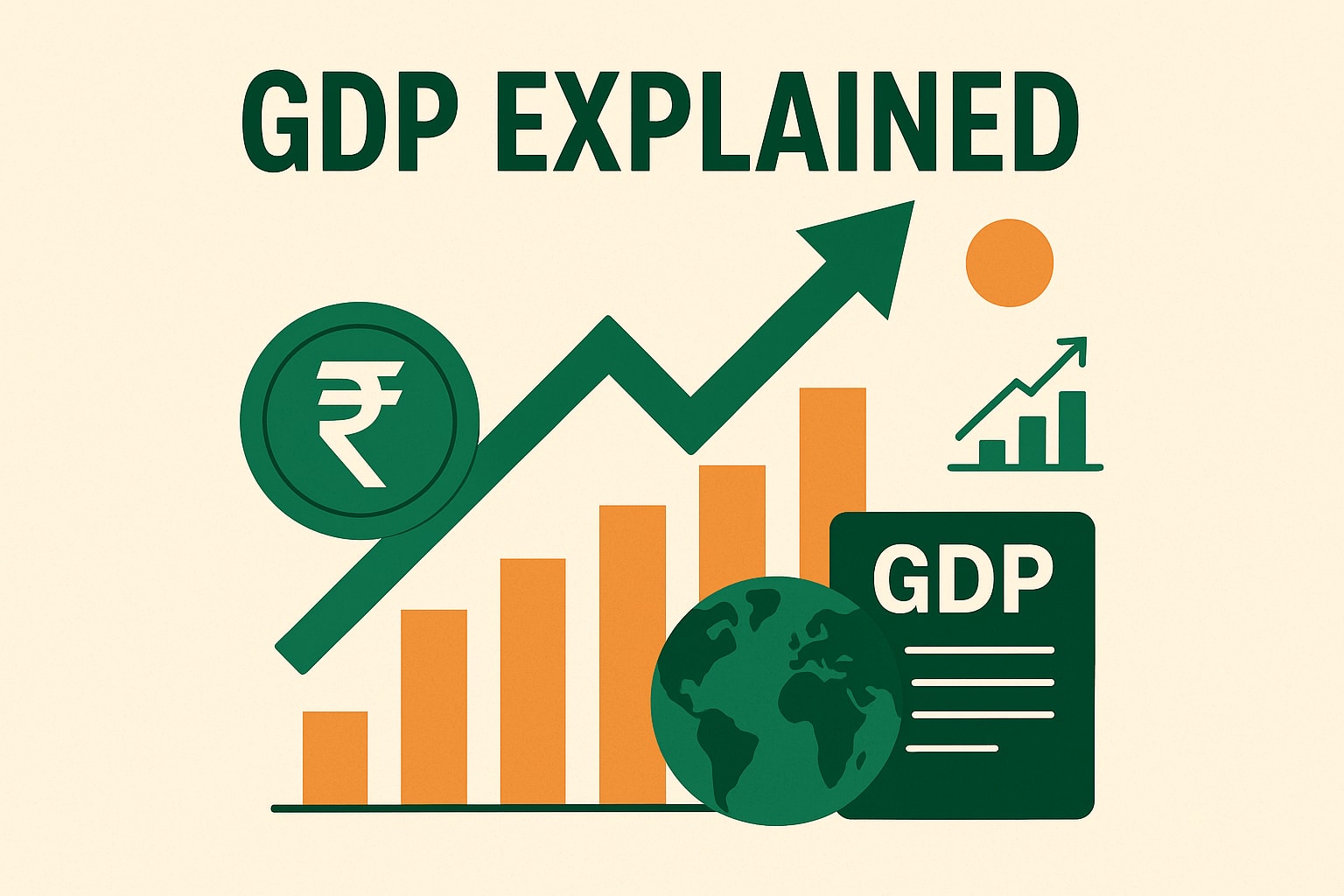
Gross Domestic Product (GDP): A Complete and Detailed Guide
The term GDP (Gross Domestic Product) is one of the most commonly used indicators in economics. Governments, economists, financial institutions, businesses, and even students rely on GDP to understand the economic health of a country. GDP helps us measure how big an economy is, how fast it is growing, and how the production of goods and services changes over time.
In this detailed article, we will explore every important aspect of GDP in a simple, structured, and well-explained manner. The goal is to provide a complete understanding suitable for beginners as well as advanced learners. All content is original, descriptive, and designed to be compatible with Google AdSense policies.
What is GDP?
Gross Domestic Product refers to the total monetary value of all final goods and services produced within a country’s geographical boundaries during a specific time period—usually a quarter or a year. It tells us how much economic activity is happening and provides a clear picture of the size and strength of an economy.
In simple words:
“GDP is the total value of everything a country produces in a given period.”
Why is GDP Important?
GDP is extremely important because it acts as a mirror of the economy. When GDP rises, it means businesses are performing well, people have jobs, incomes are increasing, and governments are collecting more taxes to spend on public development.
GDP is used for various purposes such as:
- Measuring the economic performance of a country.
- Comparing economic progress between nations.
- Determining whether the economy is growing or shrinking.
- Evaluating government policies and fiscal decisions.
- Planning budgets, investments, and development projects.
- Assessing living standards and purchasing power of people.
GDP vs GNP vs NNP (Basic Difference)
Many students get confused between GDP and other economic measures such as GNP and NNP. Here’s the simplest explanation:
- GDP (Gross Domestic Product) – Value of goods and services produced within the country, regardless of who produces them.
- GNP (Gross National Product) – Value produced by citizens of a country, whether they live inside or outside the country.
- NNP (Net National Product) – GNP minus depreciation of capital assets.
So, GDP focuses on the location of production, while GNP focuses on the nationality of producers.
Components of GDP
GDP is made up of several components, and understanding them helps us know which sector contributes most to the economy. The most common formula used to calculate GDP is:
GDP = C + I + G + NX
- C (Consumption) – Spending by households on goods and services. It includes daily needs, durable goods, transportation, education, healthcare, etc. Consumption usually forms the largest part of GDP in many countries.
- I (Investment) – Expenditure by businesses on buildings, machinery, and equipment. It also includes residential housing and changes in inventories.
- G (Government Spending) – Spending on infrastructure, defense, healthcare, education, public services, etc. This excludes transfer payments like pensions or subsidies.
- NX (Net Exports) – Exports minus imports. If a country exports more than it imports, NX is positive. If imports exceed exports, NX becomes negative.
Together, these components show how individuals, companies, and governments contribute to the economy.
Types of GDP
GDP can be understood more clearly when we study its different types. These classifications help economists analyze an economy from multiple perspectives and make informed decisions. Below are the major types of GDP explained in a simple and descriptive way:
1. Nominal GDP
Nominal GDP is the total value of goods and services produced in a country during a period, measured using the current market prices. It does not adjust for inflation or changes in the price level. Therefore, if prices increase, nominal GDP may rise even if the actual production remains the same.
Example: If a country produces 100 units of a product at ₹50 each this year and 100 units at ₹60 next year, nominal GDP will increase even though production is constant.
2. Real GDP
Real GDP measures the total production using constant prices or prices of a base year. This adjustment removes the effect of inflation and gives a more accurate picture of economic growth.
Real GDP helps answer the question: “Is the economy actually producing more goods and services, or has the GDP just increased due to higher prices?”
3. GDP Per Capita
GDP per capita represents the average income or economic output per person in a country. It is calculated by dividing the total GDP by the total population.
GDP Per Capita = Total GDP ÷ Total Population
While GDP itself measures the size of the economy, GDP per capita helps evaluate the living standards of people. A higher GDP per capita usually indicates better infrastructure, more opportunities, and improved quality of life.
4. GDP at Factor Cost
This measures GDP based on the cost of factors of production such as wages, rent, interest, and profit. It excludes indirect taxes like GST but includes subsidies.
5. GDP at Market Price
This type measures GDP using the final market price of goods and services. It includes indirect taxes and excludes subsidies.
Most international institutions like the IMF and World Bank use GDP at market price as the standard measure.
6. Sector-Wise GDP
GDP is also analyzed based on major economic sectors:
- Primary Sector – Agriculture, fishing, forestry, mining.
- Secondary Sector – Manufacturing, construction, industrial production.
- Tertiary Sector – Services like banking, telecom, IT, education, healthcare, transport.
This classification helps governments understand which sector contributes the most and which needs more support.
Nominal GDP vs Real GDP
| Nominal GDP | Real GDP |
|---|---|
| Measured at current market prices. | Measured at constant base-year prices. |
| Affected by inflation. | Not affected by inflation. |
| May mislead during high inflation. | Shows true economic growth. |
| Easier to calculate. | More accurate representation of economy. |
What is GDP Deflator?
The GDP Deflator is an important measure used to adjust nominal GDP into real GDP. It represents the overall price level of goods and services in the economy.
GDP Deflator = (Nominal GDP / Real GDP) × 100
It helps economists understand how much of the change in GDP is due to inflation and how much is due to actual growth.
GDP Growth Rate
The GDP growth rate measures how much the GDP has increased or decreased compared to the previous period. It is one of the most critical indicators used to judge the economic performance of a country.
GDP Growth Rate = ((GDP of Current Period − GDP of Previous Period) / GDP of Previous Period) × 100
A high growth rate indicates expanding economic activities, while a negative growth rate signals contraction or recession.
Factors Affecting GDP Growth Rate
- Industrial and manufacturing output
- Agricultural performance
- Government spending on development projects
- Consumer demand and purchasing power
- Exports and global economic conditions
- Technological innovation and productivity
- Employment levels
GDP and Its Impact on Common People
GDP is not just a number for economists—it directly affects the daily lives of citizens. When GDP grows, more jobs are created, salaries rise, and the standard of living improves. When GDP slows down, unemployment, inflation, and economic uncertainty increase.
A strong GDP boosts:
- Employment opportunities
- Infrastructure development
- Foreign investment
- Business expansion
- Government revenue for welfare schemes
Hence, GDP growth plays a major role in shaping the economic future of a nation and its people.
Methods of Calculating GDP
Economists and statistical agencies use different methods to calculate GDP. Each method looks at the economy from a different angle, but all arrive at the same final value. The three most widely accepted methods are:
- Expenditure Method
- Income Method
- Production / Value-Added Method
1. Expenditure Method
This is the most commonly used method and focuses on the total spending on final goods and services produced within a country. It includes household consumption, business investment, government spending, and net exports.
Formula: GDP = C + I + G + (X − M)
- C (Consumption) – Household spending.
- I (Investment) – Business investments and inventories.
- G (Government Spending) – Government expenditure on public services and infrastructure.
- (X − M) – Exports minus imports (Net Exports).
This method is useful for analyzing how the behavior of consumers, businesses, and the government influences national income.
2. Income Method
The income method measures GDP by adding up all the incomes earned by individuals and businesses in the country. It includes wages, profits, rents, and taxes minus subsidies.
Formula: GDP = Wages + Rent + Interest + Profit + (Indirect Taxes − Subsidies)
This approach focuses on how economic production is distributed as income among laborers, landlords, investors, and entrepreneurs.
3. Production / Value-Added Method
The value-added method measures GDP by calculating the value that each stage of production adds to raw materials. It prevents double-counting and gives a precise measure of total production in the economy.
How It Works:
- Value of Output − Value of Intermediate Goods = Value Added
- Total Value Added in All Sectors = GDP
This method is commonly used in industries like agriculture, manufacturing, and construction.
Illustrative Example of Value-Added Method
Suppose the production of bread involves three stages:
- Farmer sells wheat to flour mill for ₹10
- Flour mill processes and sells flour to bakery for ₹20
- Bakery converts flour into bread and sells it for ₹30
Value Added at Each Stage:
- Farmer: adds ₹10
- Flour Mill: adds ₹10
- Bakery: adds ₹10
Total GDP = ₹10 + ₹10 + ₹10 = ₹30
Without value-added calculation, simply adding values would lead to double-counting (₹10 + ₹20 + ₹30 = ₹60), which is incorrect. Hence, the value-added method gives accurate results.
Limitations of GDP
Although GDP is widely used to measure economic activity, it has several limitations. It does not reflect the complete well-being or development of a nation.
1. Does Not Measure Income Distribution
GDP may grow even if wealth is concentrated in the hands of a few. It does not show inequality or how income is shared among citizens.
2. Ignores Non-Market Activities
Activities like unpaid household work, volunteer services, and social contributions are not counted even though they benefit society.
3. Environmental Damage is Not Considered
If a country produces more goods but also increases pollution, GDP still rises. Environmental sustainability is ignored in GDP calculations.
4. Does Not Measure Happiness or Well-Being
A higher GDP does not mean people are happier, healthier, or more satisfied in life.
5. Ignores the Quality of Goods
GDP measures quantity, not quality. Even if products become better and last longer, GDP may not reflect this improvement.
6. Shadow Economy Not Included
Black market transactions, unreported income, and illegal activities are not recorded in GDP, even though they affect economic activity.
Difference Between GDP and Economic Development
| GDP | Economic Development |
|---|---|
| Measures economic output. | Measures improvements in lifestyle and living standards. |
| Focuses on production and income. | Also considers health, education, equality, and environment. |
| Short-term indicator. | Long-term indicator. |
| Does not reflect inequality. | Considers fair distribution of wealth and opportunities. |
| Purely economic measure. | Socio-economic measure. |
In simple words, GDP tells you how large the economy is, but economic development tells you how good life is for the people living in that economy.
Importance of GDP
GDP plays a crucial role in determining the economic health of a country. It is one of the most widely used indicators for assessing national performance and future prospects. Governments, businesses, investors, and international organizations rely heavily on GDP data to plan policies and strategies.
1. Importance for Government
Governments use GDP to understand the pace of economic growth and to decide the type of policies needed. If GDP growth slows down, the government may increase spending, reduce taxes, or introduce welfare schemes to boost demand.
- Helps in formulating fiscal and monetary policies.
- Determines tax structure and government expenditure.
- Guides decisions on infrastructure and development projects.
- Indicates when corrective measures are required.
2. Importance for Businesses
Companies analyze GDP trends to predict market conditions. When GDP is growing, consumer spending increases, and businesses expand operations. When GDP slows, companies reduce investments to minimize risks.
- Helps estimate product demand.
- Guides investment and expansion decisions.
- Provides insight into future market opportunities.
3. Importance for Citizens
GDP growth affects the lives of ordinary people directly. A strong GDP results in better job opportunities, higher incomes, and improved living standards.
- More job availability.
- Higher salary potential.
- Better access to public services like healthcare and education.
- Improved infrastructure and transportation.
4. Importance for Investors
Investors study GDP to assess a country’s economic stability. A high GDP growth rate attracts foreign investment, boosts stock markets, and strengthens currency value.
- Signals financial stability.
- Helps evaluate market risk.
- Encourages foreign direct investment.
GDP and Inflation
Inflation and GDP are closely connected. Inflation refers to the general increase in prices over time, while GDP measures total production.
How Inflation Affects GDP
- High inflation can make nominal GDP appear higher than it actually is.
- High inflation reduces consumer purchasing power, slowing real GDP growth.
- Low and stable inflation supports healthy economic expansion.
This is why economists focus on real GDP rather than nominal GDP, as real GDP adjusts for inflation.
GDP Deflator and Inflation
The GDP deflator is a key tool to measure inflation within the economy. It compares nominal GDP to real GDP, helping identify whether price level changes contributed to GDP growth.
GDP and Employment
Employment is directly linked with GDP. When the economy grows, industries expand and hire more workers. In contrast, during slowdowns or recessions, companies reduce hiring or even lay off workers.
Key Relationships Between GDP and Employment
- Higher GDP → More jobs, higher income.
- Lower GDP → Job cuts, reduced salary growth.
- Employment levels are often used to predict upcoming GDP trends.
Economies with consistent GDP growth have stable job markets and better career opportunities for their workforce.
GDP and Investment
Investment is one of the most important components of GDP. When businesses invest in new machines, infrastructure, and technology, production increases, boosting GDP.
- High investment drives innovation and productivity.
- Low investment results in weaker growth and fewer jobs.
- Foreign investment increases GDP by bringing new capital into the country.
Investors closely track GDP growth to decide whether to invest in a country’s industries or financial markets.
India’s GDP Structure
India has a diverse economic structure composed of three major sectors: the primary sector, secondary sector, and tertiary sector.
1. Primary Sector
This includes agriculture, fishing, forestry, livestock, and mining. Historically, the primary sector was the backbone of India’s economy, contributing the largest share to GDP. Today, its share has decreased but it remains crucial, especially in rural employment.
2. Secondary Sector
This includes manufacturing, construction, energy production, and industrial activities. The secondary sector has been steadily growing with the rise of industries, factories, and organized production.
3. Tertiary Sector
The services sector is the largest contributor to India’s GDP. It includes IT, telecommunications, finance, banking, insurance, education, tourism, transport, and healthcare.
India’s service sector has made the country one of the fastest-growing major economies in the world.
Future of GDP Measurement
As economies evolve, many experts believe that GDP alone is not enough to measure true development. Countries are exploring new indicators that include:
- Human Development Index (HDI)
- Genuine Progress Indicator (GPI)
- Gross National Happiness (GNH)
- Environmental Sustainability Index
- Social Progress Index
The future of economic measurement may combine GDP with social, environmental, and technological indicators to give a more complete picture of national well-being.
Conclusion
GDP is one of the most essential tools for analyzing the economic performance of a country. It helps understand production levels, growth trends, and future possibilities. However, GDP alone cannot measure happiness, equality, or social development. A balanced approach that considers GDP along with human well-being indicators provides a more accurate representation of progress.
Despite its limitations, GDP remains a cornerstone of economic planning and continues to guide nations toward achieving sustainable growth and development.





Discussion
0 comments
No comments yet. Be the first to share your thoughts!