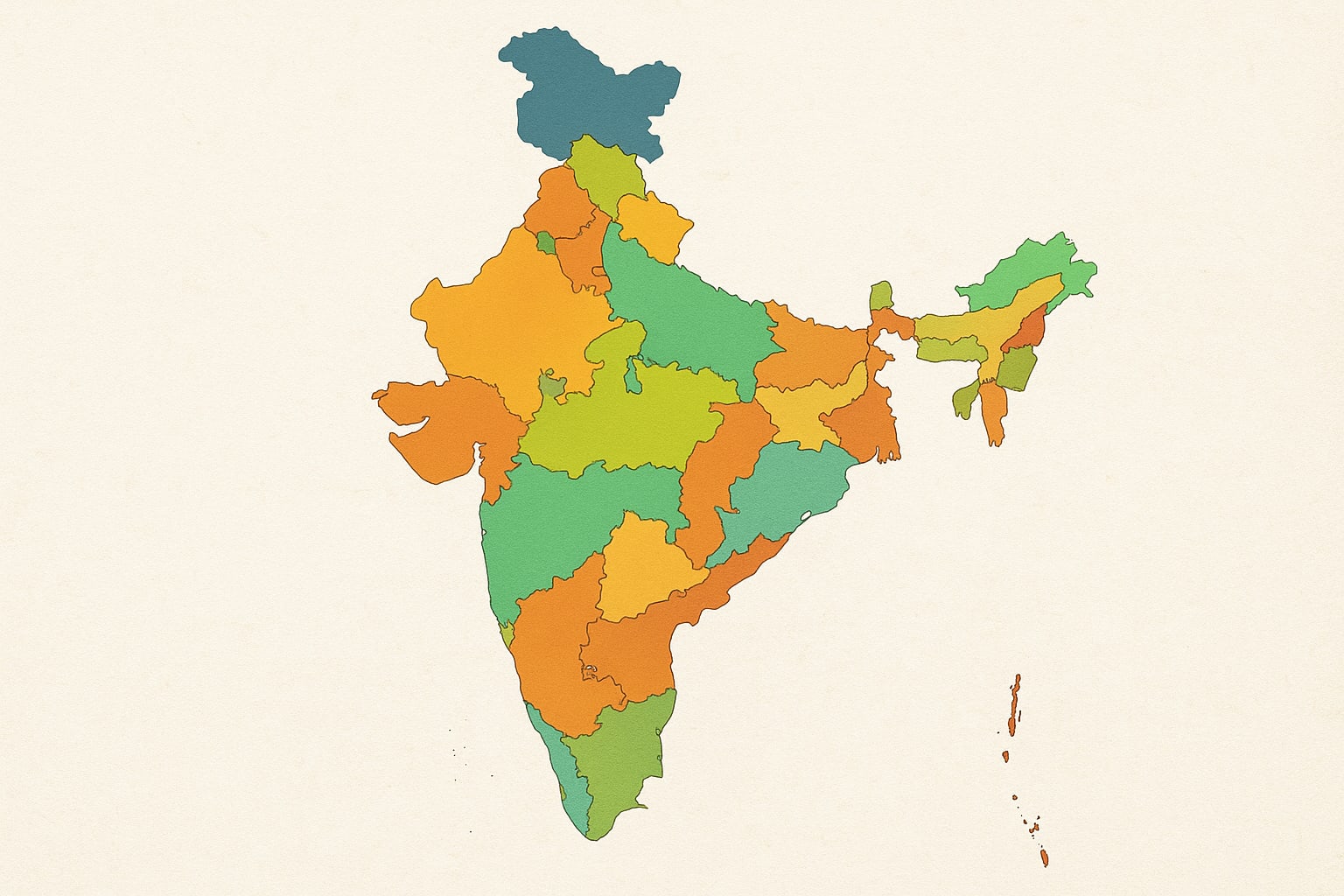
India is one of the largest and most diverse countries in the world, both geographically and culturally. To manage such vast diversity effectively, the country is divided into smaller administrative units known as States and Union Territories. These divisions play a vital role in governance, development, cultural preservation, and political administration.
The structure of Indian states reflects the country’s historical evolution, linguistic diversity, regional identities, and constitutional framework. Understanding Indian states is essential for students, competitive exam aspirants, researchers, and anyone interested in Indian geography and polity.
Administrative Structure of India
India follows a federal system of government, where power is divided between the central government and the state governments. This structure allows states to govern themselves in matters of regional importance while remaining united under one national government.
The Constitution of India defines the powers, responsibilities, and boundaries of states and Union Territories. Each state has its own elected government, while Union Territories are governed directly or indirectly by the Central Government.
How Many States and Union Territories Are There in India?
As of now, India consists of:
- 28 States
- 8 Union Territories
These administrative units together form the Republic of India. The number of states and Union Territories has changed over time due to political reorganization, state bifurcation, and administrative reforms.
Difference Between States and Union Territories
| Basis | States | Union Territories |
|---|---|---|
| Government | Elected state government | Governed by Central Government (some have legislatures) |
| Chief Executive | Chief Minister | Administrator / Lieutenant Governor |
| Autonomy | High level of autonomy | Limited autonomy |
| Examples | Uttar Pradesh, Maharashtra, Tamil Nadu | Delhi, Chandigarh, Lakshadweep |
Why Are States Important in India?
States are the backbone of Indian administration. They allow regional governance based on local needs, languages, traditions, and economic conditions. Each state contributes uniquely to India’s economy, culture, agriculture, and industrial development.
For example, some states are known for agriculture, others for industry, information technology, tourism, minerals, or cultural heritage. This balanced distribution strengthens national growth.
Constitutional Basis of Indian States
The Constitution of India provides the legal framework for the formation and governance of states. Articles 1 to 4 of the Constitution deal with the Union and its territories.
Parliament has the power to create new states, alter boundaries, or change the names of existing states. This flexibility has helped India adapt to changing political, linguistic, and administrative needs.
Overview of Indian States
India’s 28 states are spread across different regions such as North India, South India, East India, West India, Central India, and North-East India. Each state has its own capital city, official language(s), history, festivals, and economic strengths.
In the next section, we will explore each Indian state in detail, covering its background, geography, administrative setup, economy, culture, and importance.
Northern States of India
1. Uttar Pradesh
Uttar Pradesh is the most populous state in India and holds immense historical, cultural, and political significance. Its capital is Lucknow, while Prayagraj serves as the judicial capital.
The state is located in northern India and is known as the heartland of Indian civilization. Major rivers like the Ganga and Yamuna flow through the state, making the land fertile and agriculturally rich.
Uttar Pradesh plays a vital role in Indian politics and economy. Agriculture, handicrafts, small-scale industries, and tourism contribute significantly to its development. The Taj Mahal, Varanasi, and Ayodhya are globally recognized landmarks.
2. Uttarakhand
Uttarakhand, with Dehradun as its capital, is a Himalayan state known for its natural beauty, religious significance, and environmental importance.
The state is home to sacred rivers like the Ganga and Yamuna, which originate from its glaciers. Pilgrimage sites such as Kedarnath, Badrinath, Gangotri, and Yamunotri attract millions of devotees every year.
Tourism, hydropower, agriculture, and herbal industries are key contributors to the state’s economy.
3. Punjab
Punjab is an agriculturally prosperous state located in northwestern India. Chandigarh serves as its capital.
Known as the "Granary of India", Punjab plays a crucial role in food production, especially wheat and rice. The state has a rich cultural heritage deeply rooted in Sikh traditions.
Punjab’s economy is driven by agriculture, agro-based industries, and growing urban development.
4. Haryana
Haryana, with Chandigarh as its capital, surrounds the national capital Delhi on three sides and plays a key role in India’s industrial and agricultural sectors.
The state has rapidly developed as a hub for automobile manufacturing, information technology, and startups. Traditional agriculture still remains a strong foundation of its economy.
5. Himachal Pradesh
Himachal Pradesh is a mountainous state located in the western Himalayas, with Shimla as its capital.
The state is known for its scenic landscapes, apple orchards, and eco-tourism. Hydropower generation and tourism are major economic drivers.
6. Rajasthan
Rajasthan is the largest state in India by area, with Jaipur as its capital. It is known for its deserts, forts, palaces, and royal heritage.
Despite its arid climate, Rajasthan has a diverse economy supported by tourism, mining, handicrafts, and renewable energy.
Western States of India
7. Maharashtra
Maharashtra is one of India’s most economically developed states. Mumbai, the capital, is known as the financial capital of India.
The state is a major center for finance, entertainment, manufacturing, and information technology. It also has a rich cultural and historical legacy.
8. Gujarat
Gujarat, with Gandhinagar as its capital, is located on the western coast of India. It has a long coastline and a strong maritime tradition.
The state is known for entrepreneurship, industrial growth, and large-scale infrastructure development. Industries such as textiles, chemicals, and petrochemicals play a vital role in its economy.
9. Goa
Goa is the smallest state in India by area and has Panaji as its capital. It is internationally known for its beaches, tourism, and cultural diversity.
The state has a unique blend of Indian and Portuguese heritage. Tourism is the backbone of Goa’s economy, supported by fishing and mining activities.
Central and Eastern States of India
10. Madhya Pradesh
Madhya Pradesh, with Bhopal as its capital, is geographically located at the center of India.
The state is rich in forests, wildlife, and mineral resources. Agriculture and mining are key sectors of its economy.
11. Chhattisgarh
Chhattisgarh was carved out of Madhya Pradesh and has Raipur as its capital. It is known for its tribal culture and mineral wealth.
The state plays a significant role in steel production, power generation, and mining.
12. Bihar
Bihar, with Patna as its capital, has a rich historical legacy linked to ancient Indian civilizations.
Agriculture forms the backbone of Bihar’s economy, and the state is undergoing gradual industrial and educational development.
13. Jharkhand
Jharkhand, with Ranchi as its capital, is rich in minerals and forest resources.
Mining, steel production, and tribal culture define the identity and economy of the state.
Southern States of India
14. Andhra Pradesh
Andhra Pradesh is located on the southeastern coast of India, with Amaravati as its capital. The state has a long coastline along the Bay of Bengal, which supports agriculture, fisheries, and trade.
Agriculture remains a key economic activity, with rice being the main crop. In recent years, the state has also focused on industrial development, information technology, and port-based infrastructure.
Andhra Pradesh is culturally rich, known for classical dance forms, ancient temples, and Telugu literature.
15. Telangana
Telangana was formed in 2014 as India’s 29th state, with Hyderabad as its capital. The state was created to address regional development concerns and cultural identity.
Hyderabad is a major center for information technology, pharmaceuticals, and biotechnology. The state has experienced rapid economic growth driven by infrastructure and innovation.
16. Tamil Nadu
Tamil Nadu is one of the oldest cultural regions in India, with Chennai as its capital. The state has a strong identity rooted in Tamil language, literature, and Dravidian architecture.
Tamil Nadu is among India’s most industrialized states, leading in automobile manufacturing, textiles, electronics, and renewable energy.
17. Karnataka
Karnataka, with Bengaluru as its capital, is a major technological hub of India. Bengaluru is often referred to as the "Silicon Valley of India".
The state has a balanced economy supported by IT services, agriculture, biotechnology, and tourism. Karnataka is also known for its rich history, classical music, and heritage sites.
18. Kerala
Kerala is located along the southwestern coast of India, with Thiruvananthapuram as its capital. The state is globally recognized for its high literacy rate, healthcare system, and human development indicators.
Tourism, spices, fisheries, and remittances from overseas workers play a significant role in Kerala’s economy. The state is also famous for its backwaters and natural beauty.
Eastern States of India
19. West Bengal
West Bengal is located in eastern India, with Kolkata as its capital. The state has played a crucial role in India’s freedom movement and intellectual development.
Agriculture, jute industries, manufacturing, and services contribute to its economy. West Bengal is also known for its literature, art, and cultural festivals.
20. Odisha
Odisha lies along the eastern coast of India, with Bhubaneswar as its capital. The state is rich in natural resources, especially minerals like iron ore and bauxite.
Odisha has a strong cultural heritage, famous for temples, classical dance forms, and traditional crafts.
21. Assam
Assam is the gateway to North-East India, with Dispur as its capital. The state is located along the Brahmaputra River and is known for its tea plantations.
Agriculture, tea production, oil refining, and tourism are key contributors to Assam’s economy. The state has rich biodiversity and wildlife reserves.
North-Eastern States of India
22. Arunachal Pradesh
Arunachal Pradesh is located in the far northeastern region of India, with Itanagar as its capital. It is known for its mountainous terrain and cultural diversity.
The economy is primarily based on agriculture, forestry, and hydroelectric potential.
23. Nagaland
Nagaland, with Kohima as its capital, is known for its tribal culture and traditions.
Agriculture, handicrafts, and tourism are important economic activities in the state.
24. Manipur
Manipur is located in northeastern India, with Imphal as its capital. The state has a distinct cultural identity expressed through dance, music, and sports.
Agriculture and handloom industries form the economic base of the state.
25. Mizoram
Mizoram, with Aizawl as its capital, is characterized by hilly terrain and lush greenery.
The state has high literacy levels and a strong community-based social structure.
26. Tripura
Tripura is a small northeastern state, with Agartala as its capital.
Agriculture, rubber production, and handicrafts support the state’s economy.
27. Meghalaya
Meghalaya, with Shillong as its capital, is known for its rainfall, hills, and unique matrilineal society.
Tourism, agriculture, and limestone mining contribute to its economy.
28. Sikkim
Sikkim is a Himalayan state in northeastern India, with Gangtok as its capital.
It is known for its natural beauty, organic farming practices, and peaceful environment.
Union Territories of India
Apart from the 28 states, India has 8 Union Territories. These regions are governed directly by the Central Government, though some Union Territories have their own legislative assemblies. Union Territories are created to ensure better administration of strategically important or smaller regions.
1. Delhi (National Capital Territory)
Delhi is the capital of India and holds special administrative status. It has an elected government along with a Lieutenant Governor.
Delhi serves as the political, cultural, and administrative center of the country. It is also a major hub for education, commerce, and transportation.
2. Jammu and Kashmir
Jammu and Kashmir is a Union Territory located in northern India. It is known for its scenic beauty, mountains, and cultural heritage.
Tourism, handicrafts, and agriculture form the backbone of the region’s economy.
3. Ladakh
Ladakh is a high-altitude Union Territory famous for its cold desert landscape, monasteries, and unique culture.
The region is strategically important and has growing potential in tourism and renewable energy.
4. Chandigarh
Chandigarh is a Union Territory that serves as the capital of both Punjab and Haryana.
It is known for its planned urban design, high living standards, and modern infrastructure.
5. Dadra and Nagar Haveli and Daman and Diu
This Union Territory was formed by merging Dadra and Nagar Haveli with Daman and Diu.
The region has a mix of industrial development, coastal tourism, and tribal culture.
6. Puducherry
Puducherry has a unique cultural identity influenced by French colonial history.
Tourism, education, and small-scale industries contribute to its economy.
7. Andaman and Nicobar Islands
The Andaman and Nicobar Islands are located in the Bay of Bengal and are known for their biodiversity and strategic location.
Tourism, fisheries, and forest resources play a key role in the local economy.
8. Lakshadweep
Lakshadweep is a group of islands located in the Arabian Sea.
It is India’s smallest Union Territory and is known for coral reefs, marine life, and eco-tourism.
Reorganization of Indian States
Since independence, India has reorganized its states to improve administrative efficiency and address linguistic and cultural aspirations.
The States Reorganization Act of 1956 played a major role in restructuring state boundaries mainly on linguistic lines. Later, new states were formed to ensure balanced development and better governance.
Unity in Diversity
India is often described as a land of "Unity in Diversity". Each state and Union Territory has its own language, traditions, cuisine, and cultural practices, yet all are bound together by a shared national identity.
This diversity strengthens India’s democracy by encouraging regional representation while maintaining national integrity.
Role of States in Indian Democracy
States play a crucial role in implementing national policies and addressing local issues. They serve as the link between citizens and the central government.
State governments are responsible for sectors such as education, healthcare, agriculture, law and order, and regional development.
Conclusion
Indian states and Union Territories together form a strong and dynamic administrative structure. Each region contributes uniquely to the nation’s growth, culture, and global identity.
Understanding the structure and significance of Indian states helps citizens appreciate the complexity and strength of India’s federal system. It also highlights how diversity and unity coexist to shape the world’s largest democracy.





Discussion
0 comments
No comments yet. Be the first to share your thoughts!