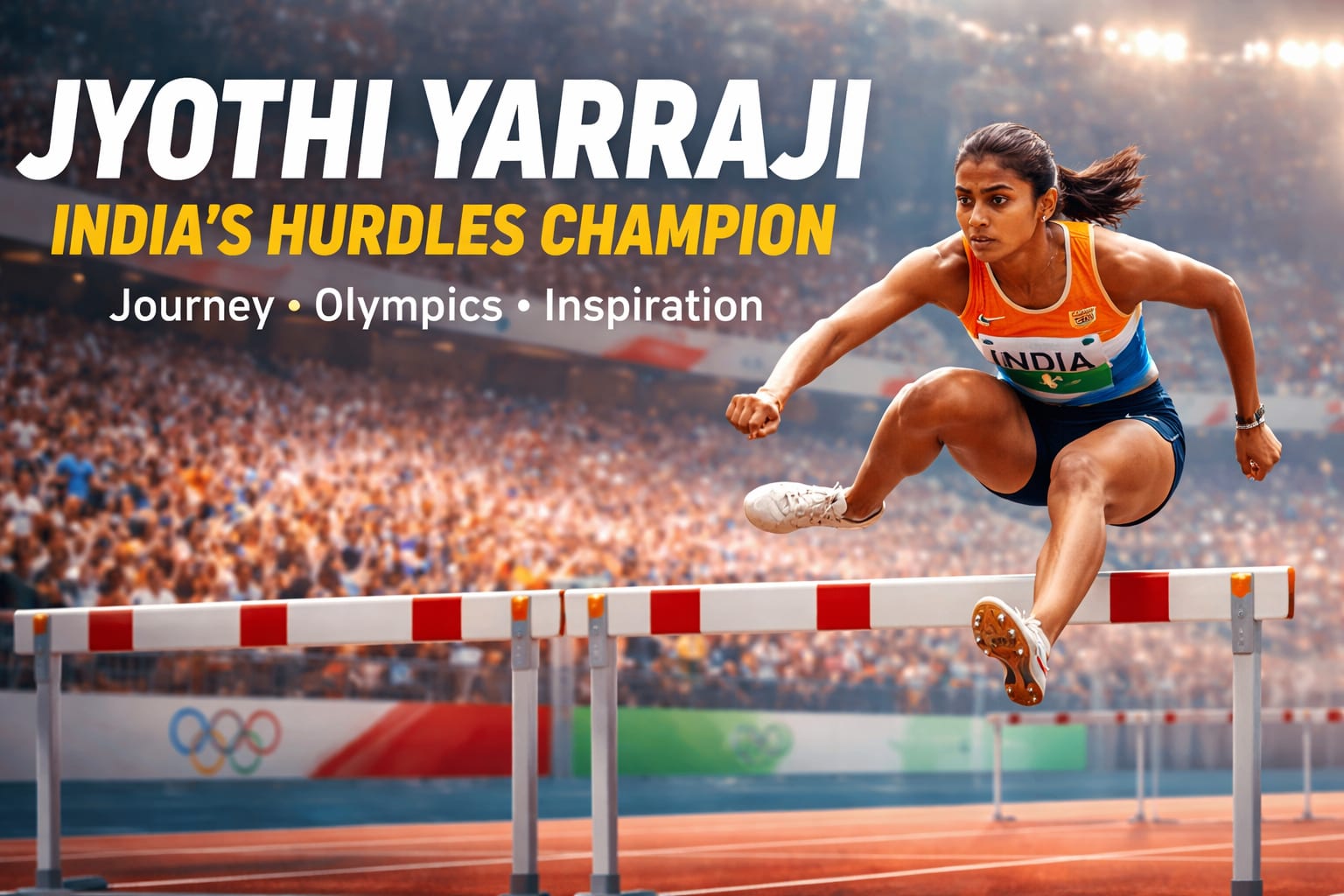
Jyothi Yarraji is one of India’s most inspiring and accomplished track and field athletes. Known for her explosive speed, technical excellence, and pioneering achievements, Yarraji has transformed the sport of hurdling in India. She became the first Indian woman ever to compete in the women's 100 m hurdles at the Olympic Games and has since broken national records, earned multiple gold medals in international meets, and gained recognition as one of the top hurdlers in Asia. :contentReference[oaicite:1]{index=1}
This article explores her journey from early life and humble beginnings to international success, her training, achievements, challenges, and the legacy she continues to build in Indian athletics. Each section is structured to provide detailed insight into her life, career, and impact.
Early Life and Inspirations
Jyothi Yarraji was born on 28th August 1999 in Visakhapatnam, Andhra Pradesh, India, into a modest family. Her early childhood was shaped by hard work, discipline, and a deep love for sports. From a young age, she showed a natural affinity for running and physical activity, traits that were noticed by her physical education teacher during school athletic meets. :contentReference[oaicite:2]{index=2}
Despite financial and social challenges, her family always encouraged her to pursue her passions. Growing up in a region where access to athletic facilities was limited, Yarraji learned to make the most of whatever opportunities came her way. This resilience and resourcefulness would later become defining aspects of her athletic success.
Discovery and Early Training
Yarraji’s extraordinary potential was recognized early on when she began participating in district and state-level track meets. Her speed and coordination stood out in sprint and hurdles events, leading to further opportunities. She was eventually selected for the Sports Authority of India’s program, which allowed her greater access to training, coaching, and competitive exposure. :contentReference[oaicite:3]{index=3}
Under structured coaching programs, she began to refine her technique in hurdle clearance, sprint starts, and race strategy — key elements that separate elite hurdlers from other sprinters. Her commitment to daily practice, physical conditioning, and mental discipline laid the foundation for her breakthrough performances at national and international meets.
As she progressed through the junior ranks, Yarraji continued to impress coaches and scouts with her consistent improvements in timing and competitive maturity, setting her on the path toward international athletics.
Competitive Breakthrough and Rise to International Stage
Jyothi Yarraji’s rise from domestic tournaments to becoming a dominant force in Asia was not sudden; it was the result of relentless consistency and self-belief. She began making headlines after breaking multiple national records in women’s hurdles, including the 100m hurdles event, establishing her position as India’s finest talent in the discipline. Her career trajectory accelerated when she started training under specialized coaches, focusing on strength, sprint bursts, stride pattern control, and advanced hurdle technique.
Each new competition brought improvement. Tournaments in Europe and Southeast Asia became learning grounds, where she not only competed against world-class athletes but also proved her capability to stand among them. These experiences gave her greater tactical maturity and confidence heading into major championships.
National Records and Breakthrough Achievements
Yarraji has repeatedly rewritten national history. By improving India’s records in hurdles multiple times, she signaled a new era for Indian sprint hurdles. Her performances also helped bring attention to a sport that often remains overshadowed by cricket, badminton, and wrestling in mainstream Indian coverage.
- National records in women's 100m hurdles with consistent timing improvements
- Gold medals in international meets, placing India on the hurdles map
- First Indian woman to compete in the 100m hurdles at the Olympic Games
- Representation in major athletics promotions and development programs
These achievements are not just personal milestones; they represent a shift in how India can perform in athletics when talent is backed with structured training and international exposure.
The Silent Stadium Incident — A Moment of Victory Without Applause
One of the most discussed moments of her journey came when she won a major race where the stadium appeared almost empty. This scene, though emotional and inspiring, also sparked important questions. A champion stood on the track, victorious, yet without thunderous applause or visible audience celebration. The silence of the stands was louder than any cheer could have been — a reminder of the struggles athletes face beyond the finish line.
This moment became symbolic. Many viewers and social media voices questioned why such a monumental achievement did not attract spectators — and whether it reflects a wider issue in the way India supports athletics beyond mainstream sports. For young athletes, audience energy is motivation, and empty stands can feel like a missing piece in their dream.
A Larger Question — Are We Supporting Our Athletes Enough?
The situation raised several uncomfortable yet necessary questions: Why do many Indian athletes still perform in front of empty seats? Why is there limited public awareness about track and field events? When an athlete achieves something extraordinary, should recognition depend only on medals or media attention?
Support is not only about finance or government schemes; it is also about presence, applause, motivation, and celebration. Many sports fans, journalists, and athletic advocates have argued that India must create stronger ecosystems — from grassroots training to public engagement — to boost morale and visibility for athletes like Yarraji.
Government and Systemic Support — A Mixed Experience
Discussions around government support often come with divided opinions. Some athletes receive structured backing from sports authorities, scholarships, and federations. Others still navigate challenges in funding, training resources, sponsorship, medical support, and international exposure. Yarraji’s journey highlights both progress and gaps in India’s sporting system.
It is not accurate to say that “nothing is being done,” because there are programs, camps, and federations working for improvement. However, many believe that the current system can be more aggressive, transparent, and athlete-centric. The lack of consistent public encouragement — especially during victories — signals a cultural gap that cannot be filled by policy alone.
“When athletes carry the nation’s hopes across the finish line, the nation should carry them back with applause.”
The real question is not whether the government supports athletes, but whether the entire sports ecosystem — including media, spectators, schools, sponsors, and associations — is ready to stand behind champions like Jyothi Yarraji with sustained enthusiasm.
Paris Olympics 2024 — A Historic Debut on the World’s Biggest Stage
The Olympic Games represent the pinnacle of achievement for athletes across the world, and in Paris 2024, Jyothi Yarraji achieved a historic milestone for Indian athletics. She became the first Indian woman ever to compete in the women's 100 metres hurdles at the Olympics, a feat that no other Indian hurdler had accomplished before her. This achievement alone places her name among the greatest pioneers in Indian track and field history. :contentReference[oaicite:0]{index=0}
Though she had narrowly missed the automatic Olympic qualification mark by a fraction of a second at one of her qualifying meets — an agonizing 0.01 seconds shy of the mark — her overall world ranking secured her a spot in the Games. This alone demonstrates her consistency at the international level. :contentReference[oaicite:1]{index=1}
Race Day — Heat and Repechage Performance
On August 7, 2024, Jyothi lined up against elite hurdlers from across the globe in the first round of heats. She clocked a time of 13.16 seconds in her heat, finishing seventh. While this timing was not enough to secure a direct semifinal qualification, it reflected her personal tenacity and effort against world-class competition. :contentReference[oaicite:2]{index=2}
In the Olympic format, athletes who do not qualify directly through the heat can run in the repechage round — a second-chance race designed to give strong competitors another opportunity to progress. In this round, Yarraji competed with full focus, clocking a time of 13.17 seconds. Despite her best effort, she finished just outside the qualifying positions for the semifinals. :contentReference[oaicite:3]{index=3}
What This Experience Means for Indian Athletics
While the Olympic journey may not have ended with a semifinal berth, the experience itself was historic and monumental. Participating in the Olympics is not just about medals; it is about breaking barriers, earning representation at the highest level, and setting new aspirations for future generations.
For many young Indian athletes, seeing an Indian woman compete in a technical and physically demanding event like the 100 m hurdles sends a powerful message — that Indian athletes can train, compete, and stand shoulder to shoulder with the world’s best. Her presence on the Olympic track was itself a victory for Indian track and field. :contentReference[oaicite:4]{index=4}
Beyond the Clock — What We Can Learn From Jyothi’s Olympic Story
Athletics is a sport of fine margins, where hundredths of a second can determine progression, podiums, or elimination. While some critics may unfairly judge performance solely by medals, the deeper story is one of perseverance and belief. Jyothi’s journey to the Olympics reflects:
- Resilience — Overcoming injuries and narrowly missing qualifying marks to still reach the Games.
- Progress — Setting national records and competing internationally with consistency.
- Representation — Showing India on an Olympic stage where it had never been before in this event.
- Inspiration — Motivating young athletes to dream without limits, especially in events where India has not traditionally excelled.
An athlete’s true legacy often emerges not only in medals but in the doors they open and the dreams they ignite. In this light, Yarraji’s Olympic debut becomes more than a race — it becomes a story of firsts and future promise.
The Broader Conversation — Recognition, Audiences & Support
While the world watched the Olympics with fervent enthusiasm, questions still linger about why some athletes — especially from sports outside the mainstream in India — do not receive widespread public attention. There are deep cultural, media, and infrastructural reasons behind this, and athletes like Jyothi often carry the weight of these conversations on their shoulders.
Being the first Indian to compete in her event, she faced not just world-class competitors, but the pressure of expectation and pride of an entire nation looking for new sporting horizons. Her journey raises a critical reflection on how India can better nurture athletes, not just through financial support, but through *awareness, visibility, and shared celebration* of their achievements.
Hurdling Excellence — Jyothi’s Training Methodology & Technical Approach
Hurdling is not just about speed. It is a balance between rhythm, coordination, acceleration, stride control, hurdle clearance technique, landing stability, and rapid transition between obstacles. Jyothi Yarraji’s training routine reflects this complexity. Her preparation is structured around multiple phases — each designed to enhance specific athletic abilities required for international-level hurdling.
1. Speed and Acceleration Training
Sprinting workouts form the base of her performance. These sessions typically include 30m, 60m, and 100m sprint repetitions focused on explosive power. She works on reaction timing from the starting block, which is crucial in hurdle events where even a 0.05-second delay can alter the race outcome.
2. Stride Pattern and Rhythm Control
Elite hurdlers maintain a consistent number of strides between hurdles. Most professionals use a three-stride pattern to maintain flow and balance. Jyothi’s sessions often include hurdle spacing drills, stride-count training, and rhythmic sprinting to maintain technique even under fatigue.
3. Strength & Conditioning
Strength training focuses on core stability, quadricep power, hamstring elasticity, and ankle stiffness — all essential for efficient takeoff and landing. Exercises such as plyometrics, weighted sprints, and balance training develop the body to endure high-impact repetition.
4. Technique and Video-Based Correction
Modern sports science has entered Indian athletics more prominently in recent years. Athletes like Jyothi often undergo video analysis to correct knee lift, body angle over hurdles, hand coordination, and landing posture. This has played a key role in her consistent improvement.
5. Recovery, Nutrition, and Mental Conditioning
At the elite level, training is not about pushing limits every day; it is about adaptation and recovery. Rest cycles, physiotherapy, injury-prevention routines, and mental coaching help ensure physical longevity. Olympic-level performance requires the mind to be trained as strongly as the body.
Achievements After the Olympic Campaign
The end of the Paris Olympics was not a destination but a checkpoint. After the Games, Jyothi continued participating in international meets and national events to maintain competitive momentum. Her focus has remained on improving timing, participating in European circuits, and preparing for future championships, including Asian level competitions and global athletic forums.
While medal counts may vary depending on the season and competition, the greatest achievement is her sustained presence in top-tier athletics, something that sets a benchmark for upcoming Indian hurdlers. Her journey demonstrates that excellence is a continuous process — not defined by a single victory or moment.
Inspiring India’s Youth — A New Era of Belief
India is a nation with more than 1.4 billion people — yet the number of world-class track athletes remains relatively small. The presence of figures like Jyothi Yarraji helps break psychological barriers. Her story shows young athletes from modest backgrounds that:
- You do not need to be born into privilege to dream like champions.
- Global standards are not unreachable; they are achievable with the right preparation.
- Sports beyond cricket also deserve ambition, investment, and audience belief.
- Failure in a race is not the end — it is a data point for improvement.
The Cultural Challenge — Audience, Visibility & Recognition
Despite progress, track and field events in India still struggle for mainstream attention. This is not because of lack of talent — but due to lack of public engagement and consistent promotion. When stadiums remain partially empty or when victories do not make national headlines, it sends a message to athletes that their victories belong only to themselves.
This lack of applause affects motivation. Athletes perform with heart, not just muscle — and the crowd’s energy is fuel. Nations that dominate athletics have one thing in common: a public culture of enthusiastic sports citizenship.
“If talent is the seed, support is the soil — and without both, no champion can grow.”
The Way Forward — What Needs to Change
The path to global sporting success for India is not mysterious — it is visible in the models of leading athletic nations. For stronger futures in track and field, India can focus on:
- Grassroots training programs in schools and colleges.
- Government initiatives that highlight niche sports and technical events.
- Public campaigns to broadcast and celebrate athletes consistently.
- Corporate sponsorships that go beyond cricket and badminton.
- Sports science integration in domestic training centers.
- Media storytelling that treats athletes like national assets, not seasonal headlines.
With these improvements, the next generation can build on the foundation laid by pioneers like Jyothi Yarraji — not starting from zero, but from history.
A Message to Every Reader
If we want Olympic medals in future, we must first build an Olympic mindset. Cheering a champion is not just celebration — it is investment. Believing in athletes before their medals is how medals are made. Athletes like Jyothi Yarraji have already shown what is possible. Now, it is our turn — as audiences, parents, policymakers, writers, media, citizens — to show what we are capable of.
As her journey continues, one truth remains clear: the finish line is not the end; it is where the next race begins.


Discussion
0 comments
No comments yet. Be the first to share your thoughts!