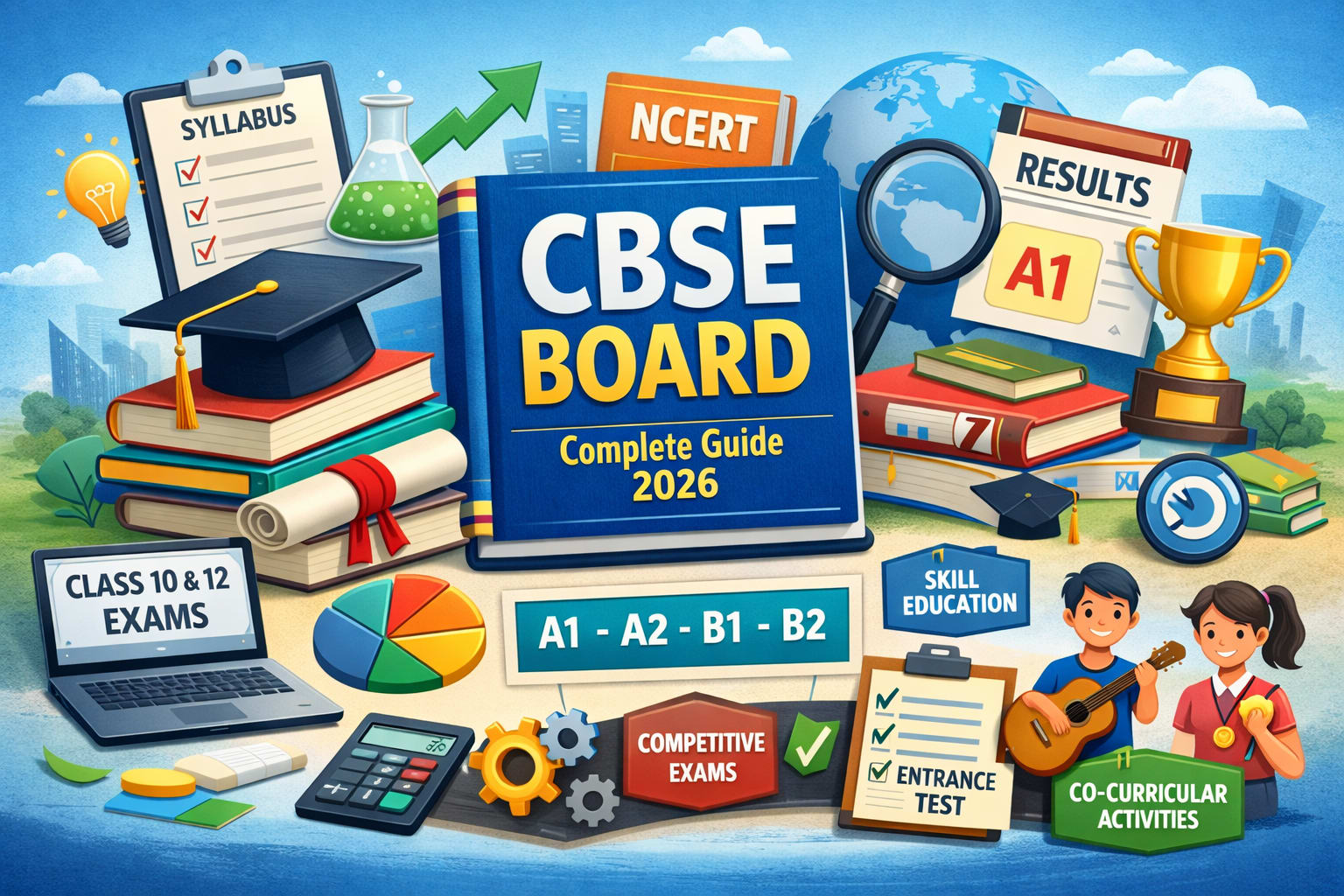
The Central Board of Secondary Education (CBSE) is one of the most prominent and widely recognized national-level education boards in India. Millions of students across India and abroad study under the CBSE curriculum every year. Known for its structured syllabus, uniform education system, and student-focused reforms, CBSE plays a vital role in shaping the academic foundation of students.
This detailed guide explains everything about the CBSE Board in a simple and descriptive way. Whether you are a student, parent, teacher, or someone planning to choose the right education board, this article will help you understand the CBSE system clearly.
What is CBSE Board?
CBSE stands for Central Board of Secondary Education. It is a national-level education board in India that operates under the Ministry of Education, Government of India. The board is responsible for developing curriculum, conducting examinations, and maintaining academic standards for affiliated schools.
CBSE-affiliated schools follow a uniform syllabus across the country, which ensures consistency in education irrespective of the student's location. This is one of the key reasons why CBSE is preferred by families who move frequently due to transferable jobs.
History of CBSE Board
The roots of CBSE can be traced back to the year 1929, when the board was established as the "Board of High School and Intermediate Education, Rajputana." Over time, its scope expanded, and in 1962, it was reorganized as the Central Board of Secondary Education.
The primary objective behind the formation of CBSE was to provide a standardized education system for students across different regions of India. Since then, CBSE has continuously evolved to meet the changing educational needs of students.
Today, CBSE has thousands of affiliated schools not only in India but also in several foreign countries, making it one of the largest education boards in the world.
Governing Authority and Administration
CBSE operates under the supervision of the Ministry of Education (formerly Ministry of Human Resource Development), Government of India. The board is managed by a Chairperson and several academic and administrative committees responsible for policy-making, syllabus design, and examination reforms.
The board works closely with organizations such as the National Council of Educational Research and Training (NCERT) to ensure that the curriculum is academically sound, relevant, and aligned with national education goals.
Objectives of CBSE Board
The CBSE Board was established with several clear objectives that focus on holistic student development rather than rote learning.
- To provide a uniform and structured education system across India
- To promote conceptual understanding instead of memorization
- To prepare students for competitive and national-level entrance examinations
- To encourage skill-based and application-oriented learning
- To support overall personality development of students
Reach and Popularity of CBSE
CBSE is one of the most popular education boards in India. It has a vast network of affiliated schools including government schools, private schools, Kendriya Vidyalayas, and Jawahar Navodaya Vidyalayas.
Apart from India, CBSE-affiliated schools are present in countries such as the UAE, Saudi Arabia, Singapore, Nepal, and other regions with a significant Indian population. This global presence makes CBSE an ideal choice for students who may study abroad in the future.
Why CBSE is Important for Students
CBSE is designed to build a strong academic foundation for students from an early stage. The curriculum emphasizes core subjects like Mathematics, Science, and Languages, which are crucial for higher education.
Most national-level competitive exams in India, such as JEE, NEET, and other entrance tests, are closely aligned with the CBSE syllabus. This gives CBSE students an advantage during exam preparation.
CBSE Curriculum Structure
The CBSE curriculum is designed in a progressive and structured manner, keeping in mind the academic growth and psychological development of students. The curriculum focuses on conceptual clarity, practical understanding, and application-based learning rather than rote memorization.
CBSE follows a centralized curriculum framework that is implemented uniformly across all affiliated schools. The board regularly updates the syllabus to ensure it remains relevant, balanced, and aligned with modern educational needs.
CBSE Education Levels
The CBSE education system is divided into different stages, each focusing on specific learning outcomes and skill development.
- Primary Level: Classes I to V
- Middle Level: Classes VI to VIII
- Secondary Level: Classes IX and X
- Senior Secondary Level: Classes XI and XII
Each stage has a carefully designed syllabus that builds upon the knowledge gained in the previous level, ensuring smooth academic progression.
Primary Level Curriculum (Classes I to V)
At the primary level, CBSE focuses on developing basic literacy, numeracy, and communication skills. The aim is to create a strong foundation while making learning enjoyable and stress-free.
- Languages (English, Hindi, or regional language)
- Mathematics
- Environmental Studies
- Art, Music, and Physical Education
Activity-based learning, storytelling, and interactive methods are encouraged to enhance curiosity and creativity among young learners.
Middle School Curriculum (Classes VI to VIII)
The middle school stage introduces students to subject-specific learning. The curriculum becomes more structured and analytical while maintaining a balance between academics and co-curricular activities.
- English and Hindi
- Mathematics
- Science
- Social Science (History, Geography, Civics)
- Computer Education
Emphasis is placed on developing critical thinking, logical reasoning, and problem-solving abilities during this stage.
Secondary Level Curriculum (Classes IX and X)
The secondary stage is academically significant as it prepares students for board examinations. CBSE focuses on strengthening core concepts and analytical skills required for higher studies.
- English or other language subjects
- Mathematics (Standard or Basic)
- Science
- Social Science
- Information Technology or Skill-based subjects
Practical exams, internal assessments, and competency-based questions are included to test students beyond theoretical knowledge.
Senior Secondary Curriculum (Classes XI and XII)
The senior secondary stage allows students to choose streams based on their interests and career goals. CBSE offers a wide range of subject combinations to support diverse academic paths.
Major Streams Offered:
- Science (PCM / PCB)
- Commerce
- Humanities / Arts
Students can also choose elective and skill-based subjects such as computer science, entrepreneurship, psychology, physical education, and more.
Medium of Instruction in CBSE
CBSE primarily offers education in English and Hindi as the medium of instruction. However, schools may offer additional regional or foreign languages as optional subjects.
English-medium instruction is widely preferred, especially by students preparing for national and international competitive exams. The language curriculum is designed to improve reading, writing, speaking, and comprehension skills.
Role of NCERT in CBSE Curriculum
CBSE closely follows textbooks published by the National Council of Educational Research and Training (NCERT). These books are considered authoritative and are recommended for all CBSE examinations.
NCERT textbooks are known for their clarity, simplicity, and concept-based approach, making them suitable for both school exams and competitive exam preparation.
CBSE Examination System
The CBSE examination system is designed to evaluate students in a comprehensive and balanced manner. Instead of focusing only on final exams, CBSE emphasizes continuous assessment, conceptual understanding, and real-life application of knowledge.
Over the years, CBSE has introduced several reforms to reduce exam stress and promote competency-based learning. The examination pattern now includes a mix of objective, short answer, and descriptive questions.
Assessment Structure in CBSE
CBSE follows a balanced assessment structure that includes both internal and external evaluations. This approach ensures that a student’s performance throughout the academic year is taken into account.
- Internal Assessment: Conducted by schools
- External Assessment: Conducted by CBSE board
Internal assessments include periodic tests, assignments, projects, class participation, and practical work, while external assessments consist of annual or board examinations.
Internal Assessment in CBSE
Internal assessment plays a crucial role in the CBSE evaluation system. It encourages students to remain consistent in their studies rather than relying solely on final examinations.
- Periodic written tests
- Notebook submission and subject enrichment activities
- Projects and presentations
- Practical exams and viva
These assessments help teachers evaluate a student's understanding, creativity, and practical application of concepts throughout the academic session.
External Assessment and Board Examinations
External assessments are conducted by CBSE for Classes X and XII and are commonly referred to as board examinations. These exams are standardized and conducted simultaneously across all affiliated schools.
Board examinations aim to test a student’s conceptual clarity, analytical ability, and writing skills. The question papers are designed as per the prescribed syllabus and sample paper guidelines released by CBSE.
CBSE Class 10 Board Examination
The Class 10 board examination is a milestone in a student’s academic journey. It marks the completion of secondary education and helps students decide their future academic stream.
Students are assessed in core subjects such as Mathematics, Science, Social Science, and Languages. CBSE offers flexibility in Mathematics by allowing students to choose between Standard and Basic levels.
The exam pattern includes competency-based questions, case-study questions, and application- oriented problems to test practical understanding.
CBSE Class 12 Board Examination
The Class 12 board examination is crucial for students planning higher education and careers. The marks obtained in this exam are often considered for college admissions and eligibility for entrance examinations.
CBSE conducts Class 12 exams for all streams including Science, Commerce, and Humanities. Practical exams and project work carry significant weightage, especially in science and skill-based subjects.
Grading System in CBSE
CBSE follows a grading system to reduce unhealthy competition and academic pressure among students. Grades are awarded based on marks obtained in examinations.
General CBSE Grading Scale:
- A1: 91 – 100
- A2: 81 – 90
- B1: 71 – 80
- B2: 61 – 70
- C1: 51 – 60
- C2: 41 – 50
- D: 33 – 40
- E: Below 33 (Fail)
Passing Criteria in CBSE
To pass a subject in CBSE, a student must score at least 33 percent marks, including theory and internal assessment combined. For subjects with practical exams, students must pass both theory and practical components separately.
CBSE also provides compartment exams for students who fail in one or two subjects, giving them an opportunity to improve their performance without losing an academic year.
CBSE and Competitive Examinations
One of the biggest advantages of studying under the CBSE Board is its close alignment with national-level competitive examinations. Many entrance exams in India are designed based on the CBSE syllabus, which helps students prepare more effectively.
Competitive exams such as engineering, medical, and other professional entrance tests often follow concepts and question patterns similar to CBSE textbooks, especially NCERT books. This gives CBSE students a strong academic edge.
Major Competitive Exams Supported by CBSE Curriculum
- Engineering entrance examinations
- Medical entrance examinations
- National-level scholarship exams
- Defense and central university entrance tests
Since CBSE focuses on concept-based learning, students find it easier to adapt to analytical and application-oriented questions asked in these examinations.
Skill Education and Vocational Subjects in CBSE
CBSE has introduced skill education and vocational subjects to prepare students for real-world challenges. These subjects help students develop practical skills along with academic knowledge.
Skill-based education also supports students who wish to explore career paths beyond traditional academic routes.
Popular Skill-Based Subjects Offered by CBSE
- Information Technology
- Artificial Intelligence
- Entrepreneurship
- Financial Literacy
- Retail and Marketing
- Health Care and Wellness
These subjects encourage creativity, innovation, and independent thinking among students.
Co-Curricular Activities and Holistic Development
CBSE strongly believes that education is not limited to textbooks and examinations. The board promotes co-curricular activities to support the overall development of students.
Schools are encouraged to include activities such as sports, arts, cultural programs, debates, and community service as part of the academic calendar.
Importance of Co-Curricular Activities
- Improves physical and mental health
- Builds confidence and leadership skills
- Encourages teamwork and discipline
- Enhances creativity and communication skills
CBSE integrates these activities into internal assessment to ensure students take them seriously and benefit from them.
Digital Initiatives by CBSE
To modernize education and improve accessibility, CBSE has launched several digital initiatives. These initiatives aim to support both teachers and students in the learning process.
Digital platforms help bridge the gap between traditional classroom teaching and modern technology-based education.
Key Digital Platforms and Initiatives
- Online academic resources and learning portals
- Digital teacher training programs
- Online examinations and result systems
- Virtual labs and e-learning support
These initiatives promote flexible learning and help students access quality education regardless of location.
Advantages of CBSE Board
The CBSE Board offers several advantages that make it one of the most preferred education boards in India. Its structured syllabus and student-friendly policies support both academic excellence and overall development.
- Uniform curriculum followed across the country
- Strong focus on conceptual and application-based learning
- Aligned with national-level competitive examinations
- Wide availability of quality study material
- National and international recognition
Disadvantages of CBSE Board
While CBSE offers many benefits, it may not suit every student. Some limitations should also be considered before choosing this board.
- Less emphasis on regional languages and local culture
- Curriculum can be challenging for some students
- Limited flexibility in subject combinations at certain levels
- Higher academic pressure in senior classes
CBSE vs Other Education Boards
Choosing the right education board is an important decision for students and parents. CBSE is often compared with state boards and other national or international boards.
Compared to many state boards, CBSE offers a more standardized and competitive curriculum. International boards focus on global exposure, while CBSE maintains a balance between academic depth and affordability.
The choice of board should depend on a student’s learning style, career goals, and long-term academic plans.
Who Should Choose CBSE Board?
CBSE is suitable for students who aim for national-level competitive examinations and higher education in India. It is also ideal for families with transferable jobs, as the curriculum remains consistent across locations.
- Students preparing for competitive exams
- Families with frequent relocation
- Students seeking structured and disciplined learning
- Learners interested in science, technology, and professional courses
Future Scope of CBSE Education
The future of CBSE education looks promising as the board continues to adapt to modern educational trends. With a growing emphasis on skills, digital learning, and holistic development, CBSE is evolving beyond traditional classroom teaching.
Reforms in assessment patterns, integration of technology, and inclusion of skill-based subjects are preparing students for future academic and professional challenges.
Conclusion
The Central Board of Secondary Education has played a crucial role in shaping India’s education system. With its focus on conceptual clarity, standardized curriculum, and competitive exam readiness, CBSE continues to be a trusted choice for students and parents.
While no education board is perfect, CBSE provides a balanced approach that combines academic rigor with holistic development. Choosing CBSE can be a strong step toward a stable and successful educational journey.
Discussion
0 comments
No comments yet. Be the first to share your thoughts!