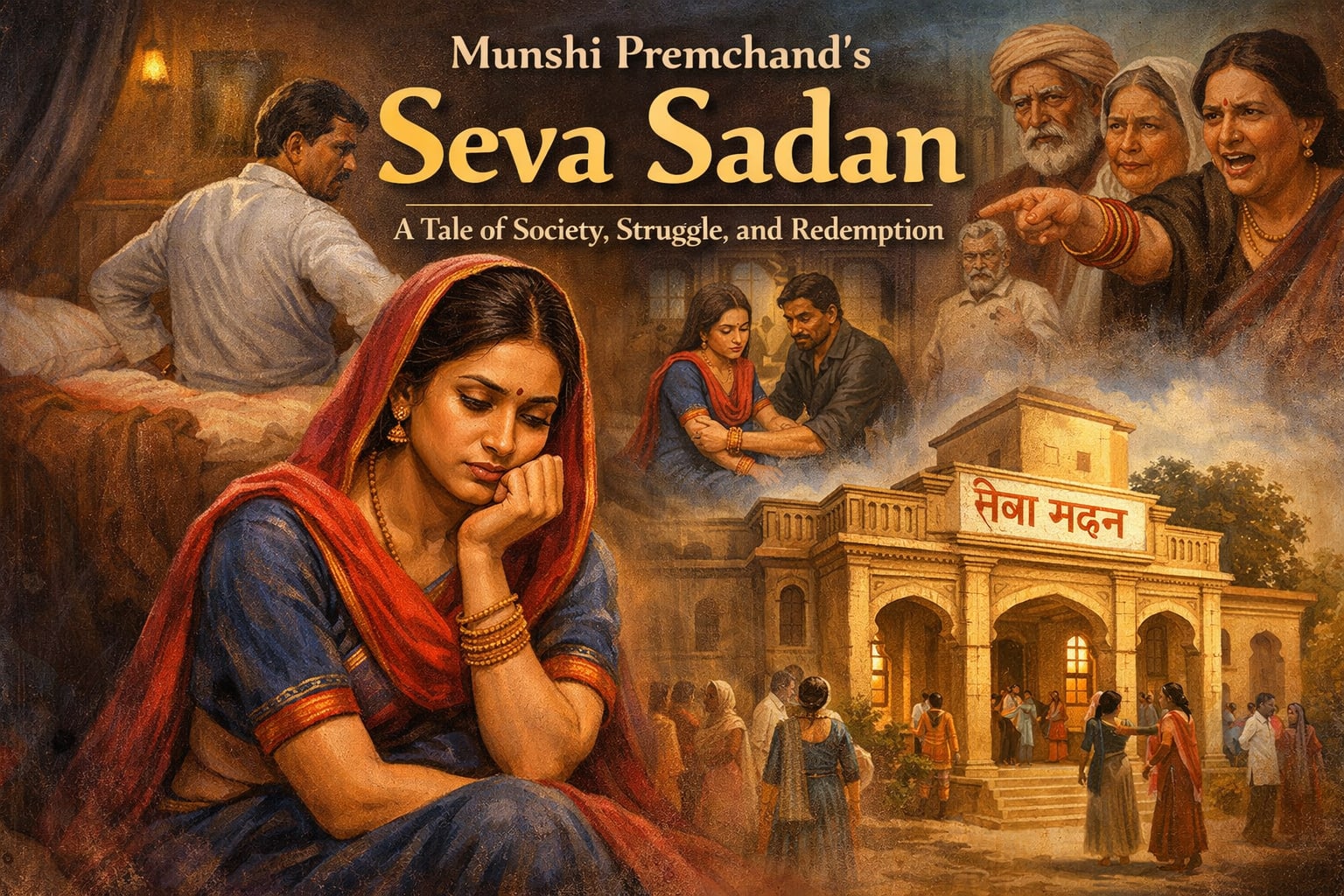
Seva Sadan is one of the most meaningful novels written by Munshi Premchand. After reading this novel, it becomes clear why Premchand is remembered as the “Upanyas Samrat” of Hindi literature. This novel is not limited to one emotion or theme; it is a complete mirror of society, covering love, pain, humor, morality, social injustice, and reform.
When I recently read Seva Sadan, I was genuinely surprised by how many layers it contains. There is emotion, there is comedy in certain situations, there is deep sorrow, and above all, there is a powerful social message. Premchand does not preach directly; instead, he lets the characters live their lives, make mistakes, suffer consequences, and evolve. Through them, he speaks to the reader’s conscience.
This blog is a detailed and simple explanation of Seva Sadan. It discusses the basic story, major characters, themes, social issues, and what Munshi Premchand wanted to tell society through this novel. The language is kept easy so that students, new readers, and literature lovers can all connect with it.
Table of Contents
- About Munshi Premchand – The Upanyas Samrat
- Background and Context of Seva Sadan
- Basic Story of Seva Sadan
- Major Characters in the Novel
- Major Themes and Social Issues
- What Premchand Wants to Tell Us
- Literary Importance of Seva Sadan
- Personal Reflection and Relevance Today
- Conclusion
About Munshi Premchand – The Upanyas Samrat
Munshi Premchand, whose real name was Dhanpat Rai Srivastava, is one of the greatest writers in Indian literature. He is known as the “Upanyas Samrat” because of his unmatched contribution to Hindi and Urdu novels and short stories.
Premchand’s writing is deeply connected with reality. Unlike romantic or imaginary literature, his stories are rooted in villages, small towns, and middle-class households. He wrote about farmers, women, widows, poor families, social hypocrisy, caste discrimination, and moral conflicts.
What makes Premchand special is his honesty. He never tries to hide the ugliness of society. At the same time, he never loses hope in humanity. His characters are not perfect heroes or villains; they are human beings with weaknesses, desires, and inner struggles.
Seva Sadan is one of those novels where Premchand’s social vision becomes very clear. Through this novel, he questions social morality and shows how society often punishes individuals instead of correcting its own flaws.
Background and Context of Seva Sadan
Seva Sadan was written during a time when Indian society was deeply conservative. Women had very limited freedom, especially in matters of marriage, education, and self-respect. Divorce was considered a sin, widow remarriage was rare, and a woman’s character was judged much more harshly than a man’s.
In this social environment, Premchand dared to write a novel that focused on a woman’s emotional, social, and moral struggles. He highlighted how society itself pushes individuals toward suffering and then blames them for it.
The title “Seva Sadan” literally means “House of Service.” Symbolically, it represents reform, self-realization, and redemption. The novel moves from personal pain to social service, showing how transformation is possible through awareness and compassion.
Basic Story of Seva Sadan (Beginning)
The story of Seva Sadan mainly revolves around a woman named Suman. She is intelligent, sensitive, and emotionally strong, but her life is shaped by the rigid structure of society. Her marriage does not bring happiness; instead, it becomes a source of constant dissatisfaction and conflict.
Suman’s husband is practical and narrow-minded. He lacks emotional depth and fails to understand her feelings and aspirations. This emotional gap slowly turns into bitterness. Suman feels trapped in a relationship where her voice has no value.
Premchand does not portray Suman as a rebellious character from the start. She tries to adjust, compromise, and accept her situation, as society expects her to. But continuous neglect and disrespect push her toward a breaking point.
This is where Premchand’s realism shines. He shows that moral downfall does not happen suddenly. It is often the result of long-term emotional suffering, social pressure, and lack of support.
As the story progresses, Suman’s life takes unexpected turns. Each decision she makes reflects not only her personal pain but also the cruelty and hypocrisy of the society around her.
Basic Story of Seva Sadan (Middle Phase)
As the story of Seva Sadan moves forward, Suman’s inner conflict becomes more intense. Her married life, instead of providing emotional security, turns into a continuous struggle for self-respect. She feels ignored, misunderstood, and emotionally isolated within her own home.
Premchand carefully shows how society expects women to silently tolerate pain. Suman is judged not for her suffering but for her reactions. Her husband’s emotional coldness is accepted as normal, while Suman’s desire for dignity is seen as arrogance.
Gradually, the lack of affection and understanding pushes Suman towards a different path. She begins to question the meaning of morality, loyalty, and social honor. Premchand does not justify every action she takes, but he makes the reader understand the reasons behind them.
One of the strongest aspects of this novel is that it does not divide characters into purely right or wrong. Instead, it presents situations where every choice has consequences. Suman’s life choices invite criticism, sympathy, and reflection all at the same time.
Major Characters in Seva Sadan
Suman
Suman is the soul of the novel. She represents thousands of women who are emotionally alive but socially restricted. She is sensitive, intelligent, and capable of deep love, yet she is denied respect and understanding.
Premchand presents Suman not as an ideal woman but as a real human being. She makes mistakes, she suffers, and she learns. Her journey from personal pain to self-awareness is the emotional backbone of Seva Sadan.
Suman’s Husband
Suman’s husband symbolizes the rigid mindset of traditional society. He is not shown as cruel in an extreme sense, but he is emotionally narrow and self-centered. His idea of marriage is based on control and social image, not mutual understanding.
Through this character, Premchand criticizes the patriarchal system where men are rarely questioned, while women are constantly judged.
Supporting Characters
The novel includes several supporting characters who represent different sections of society. Some sympathize with Suman, while others openly judge and condemn her. These characters collectively create a social environment that influences Suman’s decisions.
Premchand uses these characters to show how society functions as a system rather than as individual relationships. Even well-meaning people often become silent participants in injustice.
Emotional Depth and Inner Conflict
One of the most powerful aspects of Seva Sadan is its emotional realism. Premchand explores loneliness, emotional hunger, guilt, and self-doubt with great sensitivity. Suman’s pain is not loud or dramatic; it is slow, silent, and deeply human.
The novel also contains moments of subtle humor and irony. These moments highlight the hypocrisy of society, especially when it comes to moral judgment. Premchand often uses gentle satire to expose social double standards.
Love in Seva Sadan is shown as both a source of strength and vulnerability. The absence of emotional connection damages relationships more deeply than financial hardship or social pressure.
Major Themes and Social Issues in Seva Sadan
Seva Sadan is not just the story of one woman; it is the story of an entire society. Munshi Premchand uses this novel to expose deep-rooted social problems without exaggeration or artificial drama. Every theme in the novel feels real because it is connected to everyday life.
Condition of Women in Society
The most important theme of Seva Sadan is the condition of women in a male-dominated society. Suman’s life reflects how women are expected to sacrifice their happiness, emotions, and self-respect in the name of family honor and social norms.
Premchand questions why society gives men the freedom to make mistakes while women are punished for even expressing dissatisfaction. Through Suman, he highlights the unfair moral standards applied to women.
Marriage Without Emotional Bond
Premchand shows that marriage without emotional understanding becomes a prison. In Seva Sadan, marriage is not idealized. Instead, it is shown as a social contract that often ignores emotional compatibility.
The novel suggests that lack of communication and empathy can destroy a relationship more deeply than open conflict. Suman’s suffering is the result of emotional neglect rather than physical cruelty.
Social Hypocrisy and Moral Judgment
One of the strongest criticisms in Seva Sadan is directed at social hypocrisy. Society quickly labels individuals as immoral without understanding their circumstances. Those who follow social rules outwardly are considered respectable, even if they lack humanity.
Premchand exposes how morality is often used as a weapon to control others. People enjoy judging more than helping, and sympathy is replaced by gossip and condemnation.
Meaning and Symbolism of “Seva Sadan”
Seva Sadan is not just the title of the novel; it is a powerful symbol. It represents a place of service, reform, and inner transformation. When Suman becomes associated with Seva Sadan, her life takes a new direction.
This institution provides shelter, purpose, and dignity to women who have been rejected by society. Premchand presents Seva Sadan as an alternative moral space where compassion is valued more than social reputation.
Through this concept, Premchand suggests that real morality lies in service, understanding, and reform—not in rigid rules or social labels.
What Munshi Premchand Wants to Tell Us
Premchand’s message in Seva Sadan is clear yet deeply layered. He wants society to look inward instead of blaming individuals. He asks readers to question traditional values that lack humanity.
The novel encourages empathy over judgment. Premchand believes that social reform is impossible without understanding human suffering. Laws and morals have value only when they protect dignity and compassion.
Another important message of the novel is personal responsibility. While society plays a major role in shaping individuals, self-awareness and positive action can lead to transformation. Suman’s journey proves that redemption is possible through meaningful work and service.
Literary Importance of Seva Sadan
Seva Sadan holds a very important place in Hindi literature. It is not just a social novel but a literary work that combines realism, psychology, and reformist thinking. Munshi Premchand’s simple language and deep observation make the novel accessible to all kinds of readers.
The strength of the novel lies in its realistic characters. Premchand does not create exaggerated heroes or villains. Every character feels natural and believable, which allows readers to emotionally connect with the story.
Seva Sadan is also important because it shifted the focus of Hindi novels from fantasy and romance to social reality. It played a key role in establishing realism as a dominant literary style in Indian literature.
Relevance of Seva Sadan in Today’s Society
Even today, Seva Sadan feels surprisingly relevant. Although society has changed in many ways, issues like emotional neglect, gender inequality, social judgment, and moral hypocrisy still exist.
Women continue to face pressure to adjust and compromise, often at the cost of their mental health and self-respect. The novel reminds us that progress is incomplete without emotional understanding and equality.
The idea of Seva Sadan as a space of dignity and service is also relevant in the modern world. Institutions and communities that focus on rehabilitation, education, and empowerment continue to play an important role in social reform.
Personal Reflection: Why This Novel Feels Complete
After reading Seva Sadan, it becomes clear why Munshi Premchand is called the Upanyas Samrat. This novel contains everything—emotion, love, pain, subtle humor, and deep social awareness.
What makes the novel special is that it does not try to impress the reader with complex language or dramatic scenes. Instead, it quietly enters the reader’s mind and forces reflection. The reader begins to question society, relationships, and moral values.
Seva Sadan leaves a lasting impact because it feels honest. It does not offer easy answers, but it encourages empathy, understanding, and responsibility.
Conclusion
Seva Sadan is more than a novel; it is a social document. Through Suman’s journey, Munshi Premchand exposes the flaws of society while also showing the possibility of reform and redemption.
The novel teaches us that true morality lies in compassion, not judgment. It reminds us that society must support individuals instead of pushing them into isolation and then blaming them for their choices.
Even after many decades, Seva Sadan remains meaningful and powerful. It continues to inspire readers to think, feel, and act with humanity. This timeless quality is what makes Munshi Premchand the true Upanyas Samrat of Indian literature.


Discussion
0 comments
No comments yet. Be the first to share your thoughts!